Tornador Air Gun Review: Is the Z-020 Black Worth It?

The Tornador Z-020 Black divides detailers cleanly into two groups. Those with a capable compressor swear by it. Everyone else wonders if they bought an expensive paperweight.
This hands-on review cuts through the manufacturer’s language to tell you exactly what this pneumatic detailing gun does well, where it falls short, and whether your compressor can actually run it.


Tornador Z-020 Black: Verdict at a Glance
The Z-020 Black is a serious professional tool. It delivers strong vortex agitation for embedded interior grime, integrates a pressure regulator for surface control, and outperforms the Classic on heavily soiled fabric. The catch is real: it needs sustained airflow that most home compressors can’t maintain.
| Category | Rating | Notes |
|---|---|---|
| Cleaning power | ★★★★★ | Exceptional on embedded grime |
| Compressor demand | ★★☆☆☆ | High — most home setups struggle |
| Ergonomics | ★★★★☆ | Well-balanced, low vibration |
| Noise | ★★☆☆☆ | Loud — hearing protection required |
| Maintenance | ★★★★☆ | Serviceable, parts available |
| Value for pros | ★★★★★ | Saves significant time per job |
| Value for home users | ★★☆☆☆ | Hard to justify occasionally |
Best for: Professional detailers, mobile operators, dealership cleaning teams.
Not ideal for: Occasional home use, anyone running a small pancake compressor.
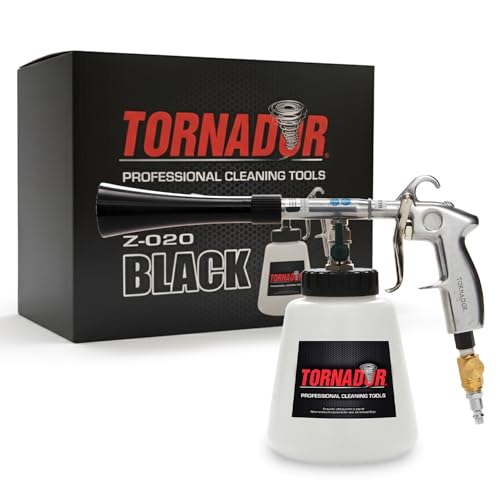
What Is the Tornador Z-020 Black?
The Tornador Z-020 Black is a compressed-air cleaning gun built around a vortex cleaning action. Compressed air spins through an oscillating internal tip and exits a cone-shaped nozzle in a rotating pattern. That rotation agitates dirt rather than simply blowing it in one direction.
It’s not a simple blow gun. The vortex motion dislodges embedded contamination from carpet fibres, fabric weaves, vent fins, and seat seams — materials that straight-line air pressure tends to miss.
Suitable surfaces include floor mats, fabric and perforated upholstery, dashboard vents, centre console gaps, door trims, and rubber seals. The official Tornador cleaning gun range covers several models, and the Z-020 sits at the top of the dry-air segment in terms of power and integrated control.
The tool agitates and loosens contamination. You still need a vacuum, microfibre towel, or extractor to remove it. This distinction matters — and most reviews gloss over it completely.
Tornador Z-020 Specifications and Compressor Requirements
This is where most buyers go wrong. They check the tank size on their compressor and assume it’s fine. Tank size isn’t the issue. Sustained airflow is.
The Tornador BLACK Z-020RS specifications list an operating pressure range of 6–9.2 bar and an air consumption of approximately 270 L/min. One North American distributor recommends at least 85 psi and around 5 CFM free airflow delivery.
Pressure Versus Airflow
PSI tells you how hard the air pushes. CFM tells you how much air flows continuously. The Tornador needs both — but consistent CFM delivery matters more during extended cleaning sessions.
A compressor rated at 150 PSI maximum but delivering only 3–4 CFM at 90 PSI will lose pressure during use. You’ll notice the vortex weakening after 30–60 seconds. Results suffer immediately.
What Compressor Size Is Realistic?
For consistent performance, target a compressor delivering at least 6 CFM at 90 PSI. A 6-gallon pancake compressor won’t cut it. Look at direct-drive or belt-drive models with tanks of 20 gallons or more.
Professional detailers typically run units producing 10–15 CFM. That headroom allows continuous use without pressure drops mid-job.
Air Preparation and Fittings
Moisture in the air line is a genuine problem. Condensation inside the nozzle degrades performance and accelerates wear. Fit an inline moisture separator before the gun. Use a 3/8-inch ID hose rather than a 1/4-inch hose — the smaller diameter chokes airflow even when the compressor is capable.
Real-World Cleaning Performance
Testing the Z-020 Black across a range of interior conditions reveals exactly where it earns its price and where it doesn’t. Check the Z-020 Black technical details for the manufacturer’s claimed applications — then compare them with what happens in practice.
Dry Debris and Floor Mats
Sand and grit trapped in carpet pile respond immediately. The rotating nozzle reaches fibres that a blower nozzle skips entirely. Two passes typically clear a heavily contaminated floor mat that would take four or five passes with a basic pneumatic gun.
This is where the Z-020 earns time savings fast. One mat that takes three minutes by hand takes under a minute with the Tornador at 85 PSI.
Vents, Seams, and Crevices
The Z-020 excels here. Vents that collect years of dust, seat-rail channels, door-speaker grilles, and console gaps respond better to vortex agitation than to any brush or vacuum attachment.
Work slowly. Let the rotation do the work rather than forcing the nozzle in tight.
Fabric, Upholstery, and Perforated Surfaces
Embedded grime in fabric upholstery requires two steps: Tornador to agitate, vacuum to extract. The gun doesn’t remove dirt. It surfaces it. On perforated leather, controlled pressure (start at 70 PSI) prevents oversaturation and avoids forcing debris through the perforations.
Pet Hair and Stubborn Contamination
This is the honest limitation. Air agitation moves pet hair, but it doesn’t collect it. Hair may redistribute across the seat rather than concentrate for easy vacuuming. For a complete pet-hair removal workflow, read our guide on how to remove pet hair from car seats and carpet — the Tornador is one tool in that process, not the solution alone.
Ease of Use, Ergonomics, Noise, and Control
The Z-020 feels balanced in the hand. The insulated grip reduces vibration fatigue during extended sessions, and the integrated swivel connector stops the air hose from torquing uncomfortably during direction changes.
The integrated pressure regulator is genuinely useful. Dial pressure down for dashboard trim and delicate plastics. Push it up for embedded carpet grime. This adjustment takes seconds and makes the tool more versatile than fixed-pressure alternatives.
Noise is a real issue. In an enclosed garage or indoor detail bay, the Z-020 generates noise levels that demand hearing protection. Don’t skip this step. Factor it into long-session use.
The learning curve is short but real. Distance from the surface, nozzle angle, and movement speed all affect results. Too close at high pressure and you’ll scatter debris rather than contain it. Start at 6 inches from the surface and adjust from there.
Setup, Maintenance, and Durability
Connection is straightforward. The Z-020 uses a standard air coupling, compatible with most UK and EU quick-release fittings. Confirm your fitting type before first use — adapters are cheap, but discovering a mismatch at the start of a job wastes time.
After use, blow the nozzle clear before storage. If you’ve used the gun in a damp environment, dry the internals by running clean, dry air through the tool for 30 seconds.
The rotating mechanism and cone seal are the primary wear components. Tornador stocks replacement parts, and the gun is designed for long-term professional service. This is a meaningful advantage over generic pneumatic cleaning guns, which often lack sourced replacement parts after a year.
Note: The Tornador BASIC dry cleaning gun is a dry-only, chemical-free tool designed for continuous blow-out work. Don’t confuse the models. The Z-020 is not interchangeable with the Classic or BASIC in terms of function or operating requirements.
Tornador Z-020 Black: Pros and Cons
Pros:
- Strong vortex agitation reaches fibres and gaps that straight-air tools miss
- Integrated pressure regulator for surface-specific control
- Fewer passes needed on heavily soiled interiors vs. Classic
- Ergonomic, low-vibration grip reduces session fatigue
- Professional build with replaceable components and long-term parts support
- Excellent reach into seams, vents, and tight console gaps
Cons:
- Demands sustained airflow most home compressors can’t deliver
- Loud in enclosed spaces — hearing protection isn’t optional
- Can scatter debris without a disciplined vacuum-first workflow
- Overkill for light dust on a single occasionally-cleaned vehicle
- Does not replace extraction, steam cleaning, or wet vacuuming
- Higher purchase price than generic pneumatic guns
Tornador Z-020 vs. Classic, BASIC, and Alternatives
| Option | Best for | Main advantage | Main limitation |
|---|---|---|---|
| Z-020 Black | Heavy-duty interior detailing | Strong agitation and integrated pressure control | High sustained airflow demand |
| Tornador Classic Z-010RS | Air-and-liquid combined cleaning | Chemical atomization with airflow | Less raw agitation power |
| BASIC Z-014RS | Dry blow-out and continuous use | Chemical-free dry cleaning design | Dry-only, no liquid capability |
| Generic pneumatic gun | Low-budget occasional use | Low-cost entry | Poor durability, limited agitation |
| Electric detailing blower | Home users without compressors | No compressor needed | Less vortex agitation, different action |
The Classic combines liquid and air, making it a different tool rather than a weaker one. Choose the Classic if your workflow involves chemical application through the gun. Choose the Z-020 if you’re doing dry-air interior agitation at high volume.
For electric alternatives, our best air blowers for car detailing roundup covers the top options for compressor-free setups. If you’re comparing the Tornador with exterior cleaning tools, check our best pressure washer gun for car detailing review — they serve completely different purposes.
For broader exterior-cleaning context, Simpson pressure washer reviews and the Seese portable pressure washer review help clarify where interior air tools end, and exterior washing equipment begins. The Ryobi 1.8 GPM pressure washer review is worth reading if you’re building a complete car-cleaning setup and need to understand how these tools complement each other.
Is the Tornador Z-020 Worth It?
It depends entirely on how often you use it and how dirty your interiors get.
For professional detailers cleaning five or more vehicles per week, the time savings justify the cost quickly. One heavily soiled interior job that takes 45 minutes by hand takes closer to 20 minutes with the Z-020. At professional rates, that difference pays for the tool within weeks.
Buy it if you’re a mobile detailer, run a dealership reconditioning operation, or detail high-volume interiors with a compressor producing at least 6 CFM at 90 PSI.
Skip it if you clean one vehicle occasionally or run a small home compressor. The tool will underperform and frustrate you.
Consider a less powerful alternative if you need air agitation occasionally without investing in compressor infrastructure. Our air blowers for car detailing guide includes electric options that don’t need a compressor at all. If your detailing budget is split between interior and exterior tools, the Westinghouse ePX3500 review and the Fanttik pressure washer review help you prioritise exterior equipment spending alongside interior tools like this one. Interior detailing investment decisions sit alongside broader car scratch repair cost considerations when budgeting for a full detailing operation.
Final Verdict and FAQs
The Tornador Z-020 Black is the right tool for the right user. It’s powerful, precise, durable, and genuinely faster than hand methods on embedded grime. It is not a home-user impulse buy.
Frequently Asked Questions
Does it work with a small home compressor?
Not reliably. A compressor producing fewer than 5–6 CFM at 90 PSI will lose pressure during extended use. Performance drops noticeably within 60 seconds on underpowered setups.
Does it remove pet hair?
It loosens and agitates pet hair but doesn’t collect it. Follow up immediately with a vacuum. Some hair redistributes across surfaces before you can capture it.
Can it replace a vacuum?
No. The Tornador surfaces contamination. Your vacuum removes it. These tools work together, not as substitutes.
Is it safe on leather and delicate trim?
Yes, with controlled pressure. Start at 60–70 PSI for delicate surfaces. Keep the nozzle moving. Don’t hold it stationary at close range on perforated leather.
Is the Black worth choosing over the Classic?
For dry-air interior agitation: yes. For liquid-and-air chemical application: the Classic is the better fit. They solve different problems.
The Z-020 Black earns its price in a professional setting. Used correctly, with the right compressor and a clear vacuum workflow, it’s one of the most effective interior agitation tools available.