Simpson Pressure Washer Reviews: Real-World Performance, Pros, Cons, and Best Models

Simpson makes some of the most respected gas pressure washers available to homeowners and light-duty pros. The brand sits in a sweet spot — more powerful than most electric models, better built than budget gas units, and still priced below commercial-grade equipment.
This review focuses on Simpson’s flagship homeowner-class gas pressure washers, particularly the PowerShot and MegaShot series in the 3,100–3,700 PSI range. You’ll get a clear verdict on performance, setup, durability, and who should actually buy one.
If you’re deciding between gas and electric, our guide on gas vs electric pressure washer for cars covers that choice in full. And if terminology is tripping you up, power washer vs pressure washer for cars clears that up fast.
Quick verdict: Simpson gas pressure washers deliver serious cleaning power with reliable starting, solid build quality, and good long-term durability. They’re not the quietest or lightest option — but for driveways, siding, and serious outdoor cleaning, they’re hard to beat at the price. Browse Simpson’s official pressure washer lineup to see current model offerings.


Simpson Pressure Washers at a Glance
Simpson Cleaning has built its reputation on gas-powered cold water pressure washers for residential and light professional use. The brand consistently appears in expert roundups because of one thing: reliable power-to-price ratio.
The core lineup runs from around 2,800 PSI entry-level units up to 4,200 PSI heavy-duty models. Most homeowners land in the 3,200–3,700 PSI class. That’s enough pressure for concrete, siding, wood decks, and vehicles — all without stepping into contractor-grade territory.
Simpson equips most mid-range models with either Honda or Kohler engines. Both are proven, easy-starting platforms. Pump choices split between axial cam (entry-level) and triplex (mid- to upper-tier), and that distinction matters a lot for durability.
Which Simpson Pressure Washer Models This Review Covers
The two most relevant lines for homeowners are the MegaShot and PowerShot series.
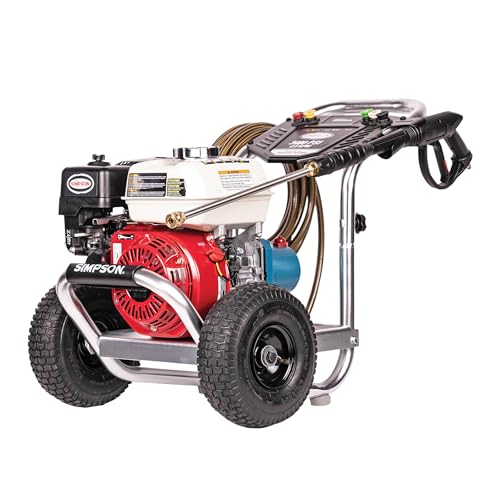
The MegaShot MSH3125-S runs 3,100 PSI at 2.5 GPM with a Honda GCV190 engine and an axial cam pump. It’s the most popular entry point. The PowerShot PS3228-S steps up to 3,200 PSI with a Simpson-branded AAA triplex pump, which offers significantly longer service life.
At the high end, the PowerShot PS61374 pushes 3,700 PSI at 2.5 GPM. That’s 9,250 cleaning units — enough to strip grime from the toughest concrete. This model is the one most frequently reviewed by independent testers and is the primary focus here.
| Model | PSI | GPM | Pump | Engine |
|---|---|---|---|---|
| MegaShot MSH3125-S | 3,100 | 2.5 | Axial Cam | Honda GCV190 |
| PowerShot PS3228-S | 3,200 | 2.5 | AAA Triplex | Honda GC190 |
| PowerShot PS61374 | 3,700 | 2.5 | AAA Triplex | Honda GX200 |
The triplex pump is the real differentiator in the PowerShot line. It lasts 3–5x longer than axial cam alternatives under regular use. If you’re cleaning large surfaces more than a few times a year, that upgrade is worth every penny.
Performance Verdict: Cleaning Power, Ease of Use, and Reliability
The PS61374 produces 9,250 cleaning units (PSI × GPM). That puts it in the top tier for residential gas washers.
On concrete driveways, it removes oil stains and embedded dirt in a single pass. Siding cleans up fast. Wooden decks need a wider spray angle to avoid gouging — but with the right nozzle, results are impressive.
Starting is one of Simpson’s biggest strengths. The Honda GX200 engine pulls to life in one or two cord pulls when warm, rarely more than three when cold. That’s not marketing language — independent test results from Consumer Reports back this up. Customer review data from Lowe’s across hundreds of verified buyers shows consistently high ratings for engine startup, often cited as the top standout feature.
Day-to-day usability is solid. The 35-foot hose covers most residential jobs without repositioning. Maneuverability is decent — the frame is heavy (around 70 lbs), but 12-inch wheels handle most terrain. Some users find the hose stiff in cold weather. That’s not unique to Simpson, but it’s worth knowing.
Noise is real. These are gas engines — expect 85–90 dB. Ear protection is recommended. If noise is a concern, an electric unit is a better fit.
Setup and First Impressions
Assembly takes 20–30 minutes for most users. Out of the box, you’ll attach the handle frame, snap the spray gun together, connect the hose, and attach nozzle tips. No tools required for most steps.
The instruction manual is clear. Simpson includes color-coded nozzle tips (0°, 15°, 25°, 40°, and a soap tip), which simplifies setup considerably. The wand clicks securely into the spray gun without wobble.
One thing to do before the first start: check and top up the engine oil. Simpson ships units without oil in the engine. Many first-time owners miss this. It’s clearly noted in the manual, but it trips people up every year.
Connecting the water supply is straightforward. Use a ¾-inch garden hose with at least 4 GPM flow to avoid cavitation. Once the water’s running and air is purged from the line, the engine starts quickly.
First impressions are consistently positive. The machine feels solid. Weight is noticeable but not unmanageable. Most users are cleaning within 30 minutes of opening the box.
Build Quality, Pump Type, and Durability
This is where Simpson earns its reputation. The frame is welded steel, not plastic. It doesn’t flex, crack, or rattle after a season of use.
The AAA triplex pump — standard on PowerShot models — is a commercial-grade component. Triplex pumps use a crankshaft-driven design with three plungers, which distributes wear more evenly than axial cam units. Expect 500+ hours of use before any significant maintenance. The hands-on expert review from TechGearLab highlights the pump as the key reason PowerShot models outlast competitors at the same price point.
Wheels are solid rubber, not pneumatic. They won’t go flat, but they absorb less vibration on rough surfaces. The 35-foot hose is 1/4-inch diameter, rated for high pressure. It’s not the most flexible hose on the market, but it holds up.
Known issues worth noting:
- Hose connection O-rings can wear out after 1–2 seasons — keep spares
- Some early units had trigger gun trigger-lock quality issues (improved in recent production runs)
- Axial cam pump models (MegaShot) require more frequent oil changes than triplex models
For homeowners using the washer 10–20 times a year, Simpson PowerShot models routinely last 5–10 years with basic maintenance — oil changes, winterizing, and fuel stabilizer before storage.
Best Uses for a Simpson Pressure Washer
Simpson gas washers are genuinely versatile. Here’s where they shine.
Driveways and concrete are the natural home turf. At 3,500+ PSI with a 15° or 25° nozzle, oil stains and tire marks lift off efficiently. Add a surface cleaner attachment and large areas clean in half the time.
House siding responds well to the 40° nozzle and the soap tip. Start with soap application from bottom to top, let it dwell for a minute, then rinse from top to bottom. Vinyl and fiber cement siding clean without damage at 1,500–2,500 PSI — use the 40° tip and maintain distance.
Decks, fences, and patio furniture clean best at the 25° or 40° setting. Wood requires care — always spray with the grain, not against it, and keep the nozzle at least 12 inches from the surface.
Vehicle cleaning works, but requires discipline. Use the 40° nozzle, maintain 18–24 inches of distance, and never use the 0° or 15° tips on painted surfaces. Our guide on what color nozzle you should use to pressure wash a car breaks this down clearly. For safe PSI ranges on vehicles, check our water pressure for car wash guide.
Consult our pressure washer nozzles chart if you’re unsure which angle to use for each job. And for vehicle detailing, pairing Simpson with a quality pressure washer gun for car detailing improves control significantly.
| Surface | Recommended Nozzle | Suggested PSI | Notes |
|---|---|---|---|
| Concrete/Driveways | 15° or 25° | 2,500–3,500 | Surface cleaner attachment ideal |
| House Siding | 40° + Soap | 1,500–2,500 | Top-to-bottom rinse |
| Wood Deck | 25° or 40° | 1,200–2,000 | Spray with the grain |
| Vehicles | 40° | 1,200–1,800 | 18–24 inch standoff distance |
| Patio Furniture | 40° | 1,000–2,000 | Test on hidden area first |
Pros and Cons
Pros
- Exceptional starting reliability — Honda GX engine pulls to life in 1–3 attempts
- High cleaning power — 3,500–3,700 PSI handles concrete, oil, and embedded grime
- AAA triplex pump durability — commercial-grade longevity in a homeowner price bracket
- Solid steel frame — no plastic flexing or cracking after a season
- Versatile nozzle kit — five tips included cover every residential surface
- Generous hose length — 35 feet covers most driveways and siding without moving the unit
Cons
- Heavy — 70 lbs limits portability for some users
- Hose stiffness — 1/4-inch hose is firm, especially in cool temperatures
- Noise — 85–90 dB requires ear protection
- Gas maintenance — oil changes, fuel stabilizer, and winterizing add upkeep compared to electric
- No electric start — recoil-only on most models
Simpson Pressure Washer Alternatives Worth Considering
Simpson isn’t right for everyone. Here are three solid alternatives.
Pressure-Pro and DeWalt gas washers compete directly in the 3,200–3,600 PSI range. DeWalt’s DXPW3600 is a popular side-by-side comparison. It uses a similar Honda engine but pairs with a CAT pump, which some pros prefer. The DeWalt is slightly heavier. Simpson generally wins on price per cleaning unit.
Westinghouse ePX3500 is a compelling electric alternative for users who clean cars and light outdoor surfaces. Our Westinghouse ePX3500 review covers how it handles vehicle-safe cleaning at 2,500 PSI. It’s lighter, quieter, and cheaper to maintain — but it can’t match Simpson on tough concrete.
Fanttik pressure washers are worth considering for car-focused buyers who want a compact, portable unit. The Fanttik pressure washer review shows how a lightweight electric option handles vehicle detailing duty without the complexity of gas operation.
For broader comparisons across the category, top-rated pressure washer picks from Popular Mechanics and best gas pressure washer benchmarks from Bob Vila both place Simpson consistently in the top tier for homeowner gas models.
If your priority is vehicle care rather than heavy-duty surface cleaning, our roundup of the best pressure washers for cars will point you toward car-friendlier options.
Final Verdict: Should You Buy a Simpson Pressure Washer?
Buy a Simpson if: You clean driveways, siding, patios, or decks regularly. You want reliable starting, serious cleaning power, and a machine built to last through a decade of seasonal use. The PowerShot PS61374 or PS3228-S are the two best picks for most homeowners.
Skip Simpson if: You mostly clean your car. You want something quiet and lightweight. You don’t want the upkeep of a gas engine. In that case, an electric unit is the smarter move.
Simpson hits the sweet spot between power and price. It’s not a professional-grade machine — but for everything a homeowner throws at it, it’s more than enough.
If you’re still comparing options, our best pressure washers for cars guide covers the full range of car-safe picks across every budget and format. Start there if vehicle care is your main goal.