Best Pressure Washers for Cars: 2026 Car-Friendly Picks

Picking the wrong pressure washer can strip clear coat off your paint in seconds. That’s not an exaggeration — it happens more than most people realize, and it happens because most “best pressure washer” lists don’t separate car washing from deck blasting. This guide does exactly that.
Every pick below is validated against the water pressure for car wash guidelines and chosen specifically for paint safety, usability at home, and real-world car washing workflows.



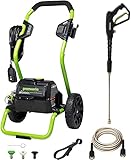


Why You Need a Car-Specific Pressure Washer
Standard gas pressure washers often run at 3000–4000 psi. That’s enough to strip wood grain from a deck. Your car’s clear coat doesn’t stand a chance.
The safe range for car washing sits between 1000 and 1800 psi. Some models running at 2000 psi are still usable if you maintain proper distance and use a wide-angle nozzle, but anything higher becomes genuinely risky on painted panels. This matters because most “best overall” lists recommend general-purpose washers that technically work on cars but weren’t built for them.
Car-specific pressure washers also tend to prioritize GPM (gallons per minute) over raw pressure. A unit with 1.5–2.5 GPM moves enough water to rinse soap effectively without the destructive force of high-PSI commercial equipment.
Paint damage from incorrect pressure washing usually shows as micro-swirls, clear coat peeling near edges, and stripped trim adhesive. All of it is preventable. Choose a washer rated for cars, keep the nozzle at least 12 inches from the surface, and you’ll get a cleaner car with zero risk.
How to Choose the Best Pressure Washer for Cars
The right pick depends on more than just price. Here’s what actually matters.
PSI and GPM are the two core specs. PSI drives cleaning force. GPM determines rinse efficiency. For car washing, prioritize models in the 1000–1900 psi range with at least 1.5 GPM. Higher GPM helps rinse foam cannon soap residue faster and reduces the time each panel needs.
Electric vs. gas is an easy call for home car washing. Electric models are quieter, lighter, require zero maintenance between uses, and produce no fumes in an enclosed garage. Gas washers are overkill for cars and almost always exceed the safe PSI range. Stick with electric.
Portability matters more than most buyers expect. A unit you can carry with one hand will get used every week. A heavy, awkward machine stays in the corner of the garage. Look for models under 15 pounds with hose-wrap storage built in.
For users with hard water, pairing your pressure washer with a good the best car wash soap for hard water prevents mineral spots after rinsing. If you plan to wash away from a tap or at a remote location, check out the best water tanks for car detailing and the best water pump for car wash for off-grid setups. You’ll also want a quality best water hose for car wash to connect everything without a pressure drop.
Ideal PSI and GPM for Car Washing
- 1000–1500 psi — safest range, ideal for delicate paint, soft-top convertibles, and wrapped cars
- 1500–1800 psi — the sweet spot for most cars, SUVs, and light trucks
- 1800–2000 psi — usable with care, proper nozzle, and 15+ inch standoff distance
- 2000+ psi — avoid on painted panels; limit use to wheel wells and undercarriage
- 1.5–2.5 GPM — the functional range; lower GPM means slower rinsing
Accessories You Actually Need for Car Washing
- Foam cannon — attaches to the pressure washer, applies thick pre-wash foam to loosen dirt before contact
- 25° or 40° nozzle tip — wide-angle spray reduces impact force on paint
- Car-specific soap — pH-neutral formulas protect wax and sealant layers
- Best water deionizer for car washing — removes minerals for spot-free drying results
- Best high-pressure water guns for car washing — a handheld option for those who want targeted rinse control without a full machine
1. Craftsman CMEPW2100 — Best Overall Pressure Washer for Cars

The Craftsman CMEPW2100 is the most-recommended electric pressure washer for everyday car washing, and the reasons are straightforward: it runs at a car-safe pressure range, sets up in under two minutes, and handles everything from weekly washes to driveway scrubbing without overcomplicating the process.
Key Features
- Operates at 1500–1800 psi, keeping painted panels and trim firmly protected
- Compact electric design eliminates gas, oil, and engine maintenance entirely
- Integrated hose storage lets you pack it away without untangling anything
Pros and Cons
Pros
- Car-safe PSI range eliminates the risk of paint or clear coat damage
- Beginner-friendly controls with no learning curve for new users
- Reliable and widely available at most major hardware retailers
Cons
- Pressure feels lighter compared to 2000+ psi competitors on heavy mud
- Not suitable for commercial-scale washing or large estate driveways
Pricing
Mid-range pricing makes this accessible without cutting corners on build quality or performance.
Our Verdict
The Craftsman CMEPW2100 earns the “best overall” label because it delivers consistent, car-safe results without demanding anything from the user. If you want one machine that handles your car and driveway without risk, this is where to start.
2. Ryobi 1.8 GPM Pressure Washer — Best Compact Car Washer
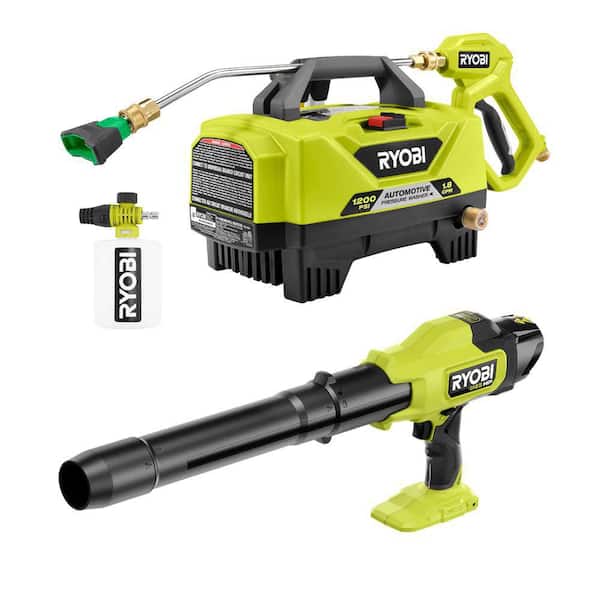
The Ryobi 1.8 GPM is built for people who want real performance in a small package. It’s one of the most storage-friendly models on this list, and the higher GPM means faster rinsing — a detail that matters when you’re working through a foam cannon routine. Read the full Ryobi 1.8 GPM pressure washer review for hands-on test data.
Key Features
- 1900 psi with 1.8 GPM delivers efficient rinsing power in a compact body
- On-board hose reel and cord wrap allow one-handed storage in tight garages
- The dual-mode nozzle switches between rinse and soap application quickly
Pros and Cons
Pros
- Compact enough to store vertically in a small garage or utility closet
- Higher GPM than many competitors speeds up the soap rinse phase
- Beginner-friendly with minimal assembly required out of the box
Cons
- 1900 psi approaches the upper car-safe limit; always use a 25° or 40° nozzle
- The soap tank is smaller than the dedicated detailing units
Pricing
Sits in the budget-to-mid-range bracket, making it an excellent value for a compact electric model.
Our Verdict
The Ryobi 1.8 GPM is the best pick for anyone with limited garage space who still wants a genuinely capable machine. The high GPM is a real advantage for rinsing foam effectively from larger SUVs and trucks.
3. Greenworks TruBrushless 2000 PSI — Most Powerful Electric for Cars
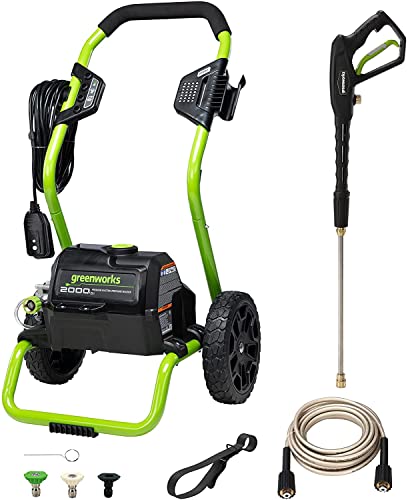
The Greenworks TruBrushless runs at 2000 psi, which technically exceeds the standard car-safe ceiling. But it earns its spot here because the brushless motor delivers that pressure smoothly and controllably, and when used at the right distance with a wide-angle nozzle, it’s genuinely safe on paint.
Key Features
- Brushless motor generates a consistent 2000 psi output without pressure spikes
- Higher pressure tackles caked mud and road grime on trucks and SUVs easily
- Durable build handles regular outdoor use across multiple seasons
Pros and Cons
Pros
- Best choice for owners of trucks, SUVs, and heavily soiled vehicles
- Brushless motor has a longer lifespan than standard induction-motor competitors
- Handles driveway and patio cleaning alongside car washing without swapping machines
Cons
- 2000 psi requires more care and proper nozzle selection near painted panels
- Heavier than the Ryobi and Craftsman models
Pricing
Mid-to-upper range, reflecting the brushless motor and higher build quality.
Our Verdict
Choose the Greenworks TruBrushless if you own a large vehicle or deal with heavy seasonal dirt. Use the 40° nozzle on paint, and you’ll never run into trouble.
4. Westinghouse ePX3500 — Best Compact for Beginners

Don’t let the model number fool you. The Westinghouse ePX3500 is surprisingly approachable for beginners, with a compact footprint and an upright rolling design that works well in tight driveways. It’s consistently listed among the best beginner-friendly electric pressure washers for car washing.
Key Features
- Compact rolling base fits easily in small garages and stores upright
- Variable pressure settings let beginners dial in a safe PSI for each task
- The onboard detergent tank simplifies foam and soap application
Pros and Cons
Pros
- Upright compact design is easy to maneuver around a vehicle
- Variable pressure gives beginners extra control and confidence
- The detergent tank built in reduces the need for a separate foam cannon
Cons
- Built-in detergent tank delivers lighter foam compared to a dedicated foam cannon
- Maximum pressure may feel unnecessary for owners of small passenger cars
Pricing
Budget-to-mid-range. One of the more affordable compact electric options on this list.
Our Verdict
The Westinghouse ePX3500 is the right choice for first-time buyers who want a solid machine without spending heavily. The built-in detergent tank makes it particularly easy to get started with zero extra accessories.
5. Fanttik NB8 Ultra — Best Cordless Pressure Washer for Cars
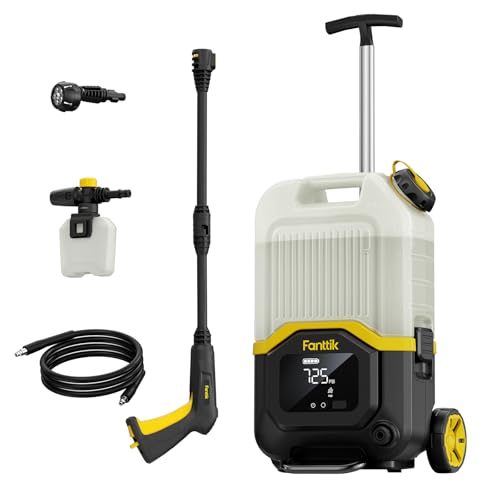
This one’s genuinely different. The Fanttik NB8 Ultra runs entirely on battery — no power cord, no outlet, no hose hookup required. It pulls water from its own reservoir or a bucket, making it the only true off-grid car washing option in this category.
Key Features
- Fully cordless battery operation requires no outlet or external water connection
- Draws water from a bucket, tank, or any clean water source nearby
- Lightweight and compact for easy transport to any location
Pros and Cons
Pros
- Perfect for apartment dwellers, van owners, and anyone without driveway outlet access
- Completely portable — fits in a car boot for on-the-go washing
- Quieter than plug-in electric models during operation
Cons
- Lower PSI than corded models — better for light rinsing than heavy dirt removal
- Battery life limits continuous use; bring a spare battery for full-car washes
Pricing
Premium compared to entry-level corded models, but the cordless functionality justifies the gap.
Our Verdict
The Fanttik NB8 Ultra solves a problem no corded washer can. If you don’t have convenient outlet access, or if you want to wash at shows, campsites, or in a shared lot, this is the only option worth considering.
6. Chemical Guys ProFlow PM2000 — Best for Car Detailing and Foam Cannon Use
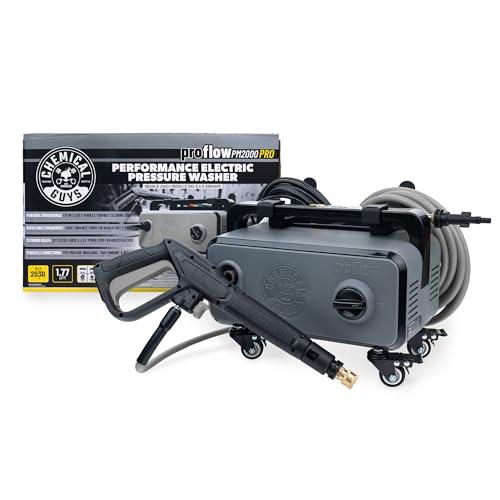
The Chemical Guys ProFlow PM2000 is designed for detailing workflows. It pairs directly with foam cannons, runs at detailing-appropriate pressure, and was built by a brand that understands exactly how car-wash chemicals behave under pressure.
Key Features
- Optimized PSI and GPM range works in tandem with foam cannons for thick coverage
- Designed with detailing workflows in mind, including soap-first, rinse-second sequences
- Compatible with Chemical Guys’ full range of car-safe soaps and snow foam products
Pros and Cons
Pros
- Purpose-built for car detailing rather than general-purpose cleaning
- Pairs perfectly with foam cannons for a professional pre-wash routine
- Chemical Guys branding means broad compatibility with the company’s detailing ecosystem
Cons
- Less versatile for non-detailing tasks like patio or deck cleaning
- Pricier than budget models for what’s essentially a specialist product
Pricing
Upper mid-range, targeting serious DIY detailers rather than casual weekly washers.
Our Verdict
If you run a foam cannon and take car cleaning seriously, the Chemical Guys ProFlow PM2000 is the natural choice. It’s the only machine on this list built specifically around a detailing-first philosophy.
7. Kärcher K1700 Series — Best Pressure Washer Under $200

The Kärcher K1700 runs at around 1000–1700 psi with approximately 1.1 GPM. That puts it at the gentler end of the car-safe range, which is actually a strength for anyone nervous about paint damage.
Key Features
- The 1000–1700 psi range is one of the safest on this list for delicate or older paintwork
- Lightweight and compact at under 12 pounds — extremely easy to carry and store
- Kärcher’s build quality is consistent and reliable over the years of regular use
Pros and Cons
Pros
- Lowest risk of paint damage among all models listed here
- Extremely affordable entry point for casual car washers
- Kärcher’s parts and accessories are widely available globally
Cons
- 1.1 GPM is below the ideal car-washing range; rinsing takes longer
- Not powerful enough for heavy mud or undercarriage cleaning on trucks
Pricing
One of the most affordable models tested — consistently available under $200.
Our Verdict
The Kärcher K1700 is the right pick if budget is the primary factor and you’re washing a well-maintained passenger car weekly. It won’t challenge tough grime, but it won’t scratch your paint either.
8. Active 2.0 Pressure Washer — Best High-Flow for Touchless Washing

The Active 2.0 flips the conventional formula. It runs at just around 700 psi but delivers 2.0+ GPM of water flow. That’s a high-volume, low-pressure approach designed specifically for touchless washing techniques where water volume — not brute force — does the rinsing work.
Key Features
- ~700 psi with 2.0+ GPM delivers maximum rinse volume with minimal impact on paint
- Ideal for two-bucket-method workflows where pre-rinse volume matters most
- Gentlest option on this list for wrapped vehicles, soft convertible tops, and fresh respray jobs
Pros and Cons
Pros
- Near-zero risk of paint, wrap, or trim damage due to low operating pressure
- High GPM volume rinses foam cannon residue faster than most competitors
- Best-in-class choice for touchless and rinseless washing techniques
Cons
- 700 psi won’t dislodge baked-on mud or heavy road contamination alone
- Less versatile for non-car tasks around the home
Pricing
Mid-range pricing for a specialized product — best viewed as a dedicated car detailing tool.
Our Verdict
The Active 2.0 is the safest possible power-washing option for delicate, high-value, or recently corrected paint. It’s built for detailers who care more about zero swirls than fast mud removal.
Quick Comparison: All 8 Pressure Washers for Cars
| Model | PSI Range | GPM | Best For |
|---|---|---|---|
| Craftsman CMEPW2100 | 1500–1800 | ~1.6 | Best Overall |
| Ryobi 1.8 GPM | 1900 | 1.8 | Best Compact |
| Greenworks TruBrushless | 2000 | ~1.2 | Most Powerful Electric |
| Westinghouse ePX3500 | 2000+ | ~1.76 | Best for Beginners |
| Fanttik NB8 Ultra | 700–900 | ~0.5 | Best Cordless |
| Chemical Guys ProFlow PM2000 | 1800–2000 | ~1.8 | Best for Detailing |
| Kärcher K1700 | 1000–1700 | 1.1 | Best Under $200 |
| Active 2.0 | ~700 | 2.0+ | Best High-Flow/Touchless |
How to Use a Pressure Washer Safely on Your Car
Getting the machine right is half the job. Using it correctly is the other half.
Start with a pre-rinse. Hold the nozzle at least 12–18 inches from the car’s surface and use a 25° or 40° tip. Work top-down — roof first, doors second, sills last. Never spray directly at panel gaps, rubber trim, or antenna bases, where water can force its way into seals.
Apply your foam cannon or detergent after the pre-rinse. Let it dwell for 2–3 minutes before rinsing. This loosens surface contamination without requiring scrubbing that introduces swirl marks. Rinse again top-down using the same 12–18 inch standoff distance.
For wheel wells and undercarriage, you can use a tighter nozzle angle (15°) and a closer distance. That area isn’t painted with the same sensitivity as your doors and bonnet.
After washing, dry the car quickly to prevent water spots. A quality best air blowers for car detailing removes water from panel gaps, mirrors, and grilles far faster than any chamois can.
Never use a 0° (red) nozzle tip on any part of your car. Ever.
Frequently Asked Questions
Is 1600 psi too much for cars?
No. 1600 psi is well within the car-safe range. Use a 25° or 40° nozzle and keep 12–15 inches of standoff distance.
Can I use a gas pressure washer on a car?
Technically, yes, but most gas models run at 2500–4000 psi. That’s far above the safe range for painted panels. Stick with electric for home car washing.
What’s the best nozzle tip for cars?
The 25° (green) tip works for most car surfaces. The 40° (white) tip is safer for delicate paint, wrapped cars, and fresh resprays. Avoid the 15° (yellow) tip on anything painted.
Do I need a foam cannon?
You don’t need one — but you should want one. A foam cannon pre-soaks the car in thick soap, loosening contamination before you touch the surface. That means less physical contact, fewer swirl marks, and a faster rinse. It’s the biggest single upgrade to a car-washing routine.