Best Water Deionizers for Car Washing 2026: Top 6 Spot-Free Systems Reviewed

Hard water spots can destroy your car’s perfect finish in minutes. Traditional tap water contains dissolved minerals that leave ugly white residue when it evaporates. Water deionizers eliminate this problem completely.
Deionizer systems use specialized resin to remove ions and minerals from water. The result is pure H2O with zero total dissolved solids (TDS). This creates spot-free rinsing that eliminates towel drying.
Professional detailers rely on deionized water for mirror finishes. Home enthusiasts discover the same benefits once they upgrade from regular hoses. The technology transforms ordinary car washing into effortless perfection.
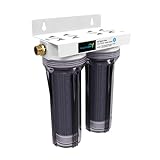
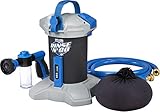


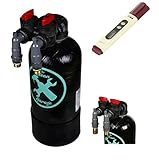


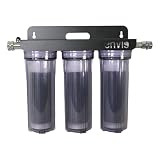
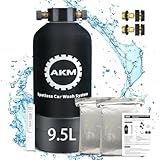
Introduction to Water Deionizers for Spot-Free Car Washing
Water deionization removes electrically charged particles from tap water through ion exchange. Mixed-bed resin cartridges capture minerals like calcium and magnesium. These cause the white spots that etch paint surfaces.
Standard city water contains 100-500 parts per million of dissolved solids. Deionized water measures under 10 ppm. Many systems achieve near-zero readings.
The benefits extend beyond aesthetics. Mineral-free water protects the clear coat from microscopic scratching. It reduces waxing frequency by preventing contamination buildup.
Commercial car washes use deionization for premium packages. Mobile detailers consider it essential equipment. Home users discover professional results without professional costs.
Hard Water vs. DI Water Comparison
| Water Type | TDS (ppm) | Spot Formation | Paint Damage Risk | Drying Required |
|---|---|---|---|---|
| Hard Tap Water | 200-500 | Severe spots | High etching risk | Immediate toweling |
| Soft Water | 50-150 | Light spotting | Moderate buildup | Quick drying needed |
| Deionized Water | 0-10 | Zero spots | No mineral damage | Air dry only |
The difference becomes obvious after your first deionized rinse. Water sheets off panels completely. No streaks remain as the surfaces air-dry naturally.
How to Choose the Best Water Deionizer for Your Car Wash
Capacity determines how many washes you’ll complete before cartridge replacement. Entry-level systems provide 200-300 gallons of pure water. Premium models exceed 500 gallons between services.
Calculate your usage based on vehicle size and wash frequency. Compact cars require 15-20 gallons for thorough rinsing. SUVs and trucks need 30-40 gallons per session.
TDS meters monitor water purity in real-time. Digital displays show when output exceeds acceptable levels. This prevents accidental spotting from depleted cartridges.
Portability matters for mobile washing or storage constraints. Lightweight units with carrying handles enable flexible use. Stationary systems offer higher capacity with permanent installation.
Dual outlets provide operational flexibility. One connection delivers deionized water for final rinsing. The bypass valve switches to regular pressure for initial soap removal.
Resin type affects longevity and performance. Mixed-bed cartridges handle varied water conditions effectively. Color-changing indicators show depletion status visually.
Maintenance requirements vary significantly between models. Some systems need a complete cartridge replacement. Others allow resin regeneration for extended service life.
DI vs. RO vs. Softeners
| System Type | Purity Level | Spot Prevention | Initial Cost | Maintenance |
|---|---|---|---|---|
| Water Softener | Moderate | Reduces spots | Low | Salt refills |
| Reverse Osmosis | 90-99% pure | Excellent | High | Filter changes |
| Deionization | 99.9% pure | Complete | Moderate | Cartridge replacement |
Water softeners exchange calcium for sodium ions. This reduces spotting but doesn’t eliminate it completely. Deionization provides superior results for car washing applications.
Reverse osmosis removes contaminants through membrane filtration. Combined RO/DI systems offer ultimate purity. Most car wash applications achieve excellent results with DI alone.
Consider your local water conditions when selecting technology. Areas with extremely hard water benefit from RO pre-filtration. Standard municipal supplies work well with quality deionizers.
The 6 Best Water Deionizers for Car Washing in 2026

1. CR Spotless DIC-20: Premium Portable System with Proven Results
Best for: Serious home enthusiasts, owners of multiple vehicles, those with hard water
Specifications:
- Capacity: 300 gallons at 100 ppm TDS
- Dimensions: 15″ L × 15″ W × 38″ H
- Weight: 50 lbs
- Flow rate: Standard garden hose pressure
- Features: Dual 20-inch deionization housings, powder-coated rolling cart, included TDS meter, stainless inlet hose, filter wrench
What makes it stand out:
CR Spotless pioneered consumer deionization for car detailing and maintains that reputation through reliability. The rolling cart design eliminates storage friction—you’re more likely to use it consistently when it’s mobile. Users consistently report zero visible water spots even on black vehicles in direct sunlight, with one owner calling it “day and night” compared to pre-deionizer washing.
The dual housing design means water flows through a substantial resin volume, extracting more minerals in a single pass. Professional detailers have frequently cited the system as their standard for over a decade, and consumer reviews average exceptional satisfaction.
The math on cost: At approximately under $700, you’re paying a premium for brand trust and the cart. Resin replacement runs $60-80 per 300-gallon cycle. For someone washing 3-4 vehicles per week with hard water, that’s roughly $300-400 annually in resin.
The limitation: At 300 gallons per resin, users with very hard water (300+ ppm) see shorter effective runs. The system is also the heaviest option, making it less portable than compact alternatives.
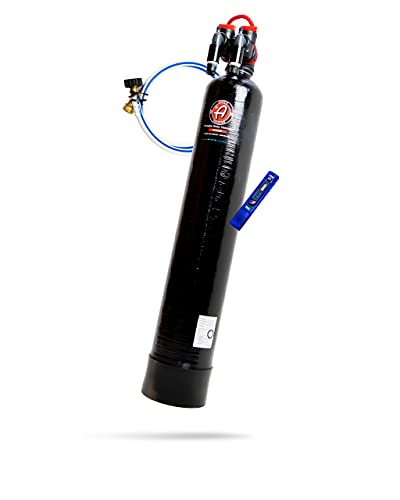
2. Adam’s Portable Spotless Water Deionizer Pro: Maximum Capacity for Serious Users
Best for: Active mobile detailers, households washing 5+ vehicles weekly, high-volume shops
Specifications:
- Capacity: 2,240 gallons at 100 ppm TDS (can rinse 220+ vehicles at 200 ppm with bypass valve)
- Resin weight: 40 lbs
- Height: 4 feet tall
- Dimensions: 10″ × 10″ footprint
- Features: Bypass valve (critical for efficiency), TDS meter, quick-connect hoses, easy cartridge swaps
What makes it stand out:
The Pro’s massive resin capacity means you replace cartridges far less frequently than smaller systems. For mobile detailers handling 10-20 vehicles per week, this translates to weeks between refills instead of days. The bypass valve is a game-changer—use regular water for the initial wash and pressure rinse, switching to DI only for the final spot-free rinse. This single feature quadruples resin longevity by using pure water only where it matters.
The slim 4-foot design fits into panel vans, sprinters, and small commercial vehicles without consuming cargo space. Unlike the CR Spotless cart-based approach, the Pro’s vertical profile suits mobile operations.
The math on cost: Approximately under $800 initial investment with replacement 40-lb resin bags at roughly $80-100 each. At 2,240 gallons per refill, your cost per gallon drops to $0.04-0.05—the lowest among consumer systems.
The limitation: Overkill if you wash 1-2 vehicles monthly. The 4-foot height may not fit certain vehicles or low-ceiling garages. Requires more careful plumbing for optimal results versus plug-and-play simplicity.
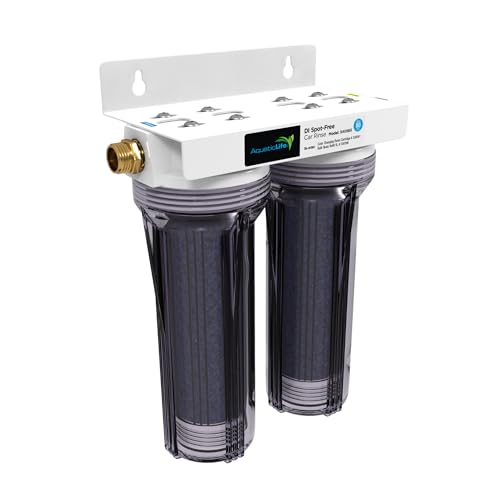
3. Aquatic Life Deionized Spot-Free Car Rinse Unit: Budget-Conscious Quality
Best for: First-time buyers, occasional users (1-2 vehicles monthly), renters with portable needs
Specifications:
- Capacity: 560+ gallons at standard water quality
- Resin: Pre-charged cation and anion mixed media
- Weight: Lightweight portable design
- Features: Refillable cartridges, straightforward hose connections, zero technical learning curve
What makes it stand out:
Aquatic Life delivers no-nonsense deionization without premium pricing. The cartridge design means zero fussing with separate canisters or complex plumbing. Drop in a new cartridge, attach your hose, and start washing. Users report effective zero-ppm water and spot-free drying even on dark vehicles.
For someone testing whether DI water actually helps before committing serious money, this system provides authentic results at entry-level pricing. The cartridge approach also means you’re never stuck with fouled resin—you simply swap the entire cartridge when TDS readings climb.
The math on cost: Typically under $400 with replacement cartridges at $30-50. Over a year of occasional washing, the total cost stays under $350.
The limitation: Lower capacity means frequent cartridge replacements for active users. The lightweight design prioritizes portability over ruggedness. No bypass valve option, so every drop of water runs through resin—accelerating exhaustion if you use it for the initial rinse.

4. On The Go Spotless Water Deionizer (Standard Model): The Balanced Middleground
Best for: Home detailers washing 2-3 vehicles weekly, those wanting flexibility without over-engineering
Specifications:
- Capacity: 1,120 gallons at 100 ppm TDS (with bypass valve)
- Resin capacity: Double the Basic model
- Weight: ~32 lbs
- Features: Bypass valve standard, included TDS meter, portable hose connections, straightforward resin replacement
What makes it stand out:
On The Go’s Standard sits in the sweet spot of efficiency. The bypass valve enables the same “wash with tap, rinse with DI” strategy as premium systems, but at a fraction of the Pro’s price and footprint. Users report rinsing 90+ vehicles before needing to refill the resin at a water hardness of 200 ppm.
The resin cart approach balances weight (portable for most people) with capacity (no weekly swaps required). This is the system that professional detailers often recommend to car-washing enthusiasts—it handles serious volume without demanding industrial-scale infrastructure.
The math on cost: Approximately under $500 with resin refills at $40-60. For someone rinsing 10 vehicles monthly, you’re looking at roughly $500-600 annually all-in.
The limitation: Heavier than compact units, so not ideal for frequent movement. The mid-range capacity leaves professional high-volume users wanting more between swaps.
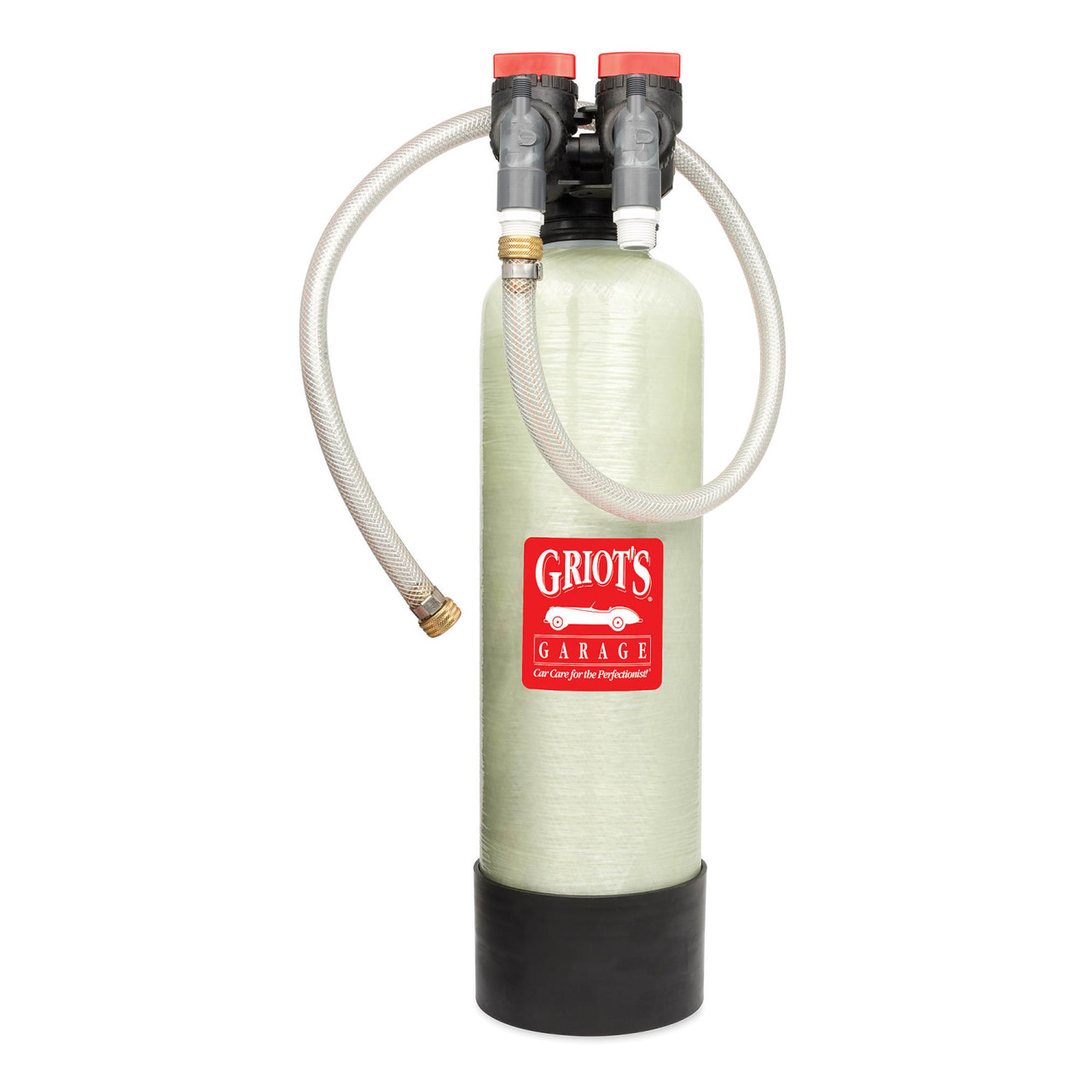
5. Griots Garage Water Deionizer: High-Flow Performance for Impatient Washers
Best for: Those who want strong pressure maintained throughout the final rinse, users with time constraints
Specifications:
- Capacity: 700-800 gallons actual (varies by water chemistry, despite manufacturer claims of 1000+)
- Flow rate: Higher than typical portable systems
- Features: Minimal setup, straightforward operation, visible performance monitoring
What makes it stand out:
Griots prioritizes water pressure throughout the rinse cycle, making it satisfying for users who dislike weak flow. The system produces visibly clean water delivery and, according to owner testing, outperforms claimed specifications when accounting for real-world water chemistry.
For someone who finds slow trickle outputs frustrating and is willing to monitor resin life closely, Griots delivers the pressure experience of a pressure washer combined with spot-free results. Testing shows actual capacity closer to 700-800 gallons than manufacturer marketing claims, but performance remains solid.
The math on cost: Comparable to competitive mid-range systems at $300-500, with resin replacement following similar patterns.
The limitation: The higher flow rate means faster resin saturation—you’ll replace cartridges more frequently than low-flow competitors. TDS monitoring becomes essential, as higher flow provides less contact time.
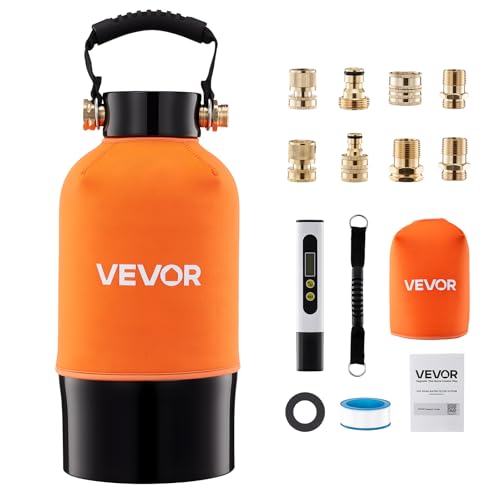
6. VEVOR Premium DI System with TDS Meter – Best Budget
Our Verdict: VEVOR’s affordable DI system with integrated TDS meter produces 320 gallons of impurity-free water for streakless home car washes.
Perfect for: Budget-conscious homeowners tackling hard water spots regularly.
The VEVOR system proves that quality deionization doesn’t require premium pricing. Built-in TDS monitoring provides confidence in water purity. Mixed-bed resin filters ions rapidly for consistent results.
Digital TDS display eliminates guesswork about cartridge condition. Green readings confirm spot-free performance. Red warnings indicate replacement timing.
Key Features:
- Integrated TDS meter displays real-time purity levels
- High-capacity mixed-bed resin for 320-gallon service life
- Dual outlet design with bypass valve functionality
- Clear housing shows resin color changes visually
- Pressure-rated construction handles standard home water systems
The dual outlet configuration streamlines the washing workflow. Connect one line to your spray gun for controlled application. The second outlet provides unrestricted flow for bucket filling.
Pros:
- TDS meter eliminates uncertainty about water quality
- Protects expensive paint from mineral etching damage
- Stable flow rate maintains consistent rinsing pressure
- Easy home installation with standard hose connections
- Excellent value compared to premium alternatives
Cons:
- Shorter cartridge life in areas with extremely hard water
- Bulkier design than ultra-portable units
- Generic cartridges may vary in quality and consistency
Best Use Case: Driveway washing of sedans and small SUVs, eliminating hard water etching while staying within modest budgets.
Built-in TDS monitoring separates this model from basic filters without purity verification. You’ll know exactly when performance declines.
FAQ
Can I use a deionizer in sub-freezing temperatures?
No. Frozen resin suffers permanent damage. Winter detailers should either drain systems completely after each use or store them indoors. Some professional shops invest in heated storage enclosures.
Do water softeners replace deionizers?
Not entirely. Water softeners (ion exchange using sodium or potassium) remove hardness minerals (calcium, magnesium) but leave behind sodium, chloride, sulfate, and other dissolved solids. A softened-water car still spots upon drying. Deionizers remove everything. Many pros use softeners for general cleaning, then finish with DI for spotless results.
Can I run a pressure washer through DI water?
Not recommended. Pressure washers output 5+ GPM, overwhelming the resin’s capacity and causing channeling. Better workflow: use regular water with a pressure washer for initial blast, then switch to low-flow DI (1–2 GPM) for final rinse. Some mobile detailers use separate systems—a high-capacity RO for pressure work and DI for final rinse.
How often should I test my source water?
Once initially to establish a baseline, then quarterly if circumstances change (new well, municipal water treatment upgrade, moving locations). Most users simply monitor outlet TDS and replace resin when it rises above 10–20 ppm in use.
Is deionized water safe for ceramic coatings?
Yes. DI water actually benefits ceramic coatings by eliminating minerals that can interfere with bonding and cause beading inconsistencies. Use DI water during ceramic-coating application and maintenance washes.
What happens if I leave DI water in a spray bottle?
Nothing harmful, but DI water can absorb CO₂ from the air, slightly increasing conductivity (TDS). For final-rinse bottles, refill immediately before use rather than storing DI water long-term. Some detailers add a small amount of distilled water mixed with 5% diluted sealant to bottles for enhanced beading, but this is cosmetic, not essential.
Final Thoughts & Top Picks Recap
The right deionizer transforms car washing from a tedious chore to a satisfying routine. No more frantic towel drying before spots form. Pure water sheets off naturally for perfect finishes.
Match your system to usage patterns carefully. Occasional washers succeed with portable units. Weekly detailers benefit from high-capacity models. Commercial applications demand professional-grade durability.
Our Top Recommendations by Use Case:
- Best overall value for hobbyists: Adam’s Standard Portable Spotless Water Deionizer.
- Best for absolute beginners: Unger Rinse ‘n’ Go.
- Best for serious enthusiasts: Adam’s Pro.
- Best for mobile professionals: Griots Garage Deionizer.
- Best all-in-one system for hard-water areas: CR Spotless DIC-20.
Remember cartridge replacement timing to maintain performance. Monitor TDS readings religiously. Replace cartridges before purity declines noticeably.
Consider pairing your deionizer with air blowers for car detailing to achieve completely touchless drying. The combination delivers professional results without professional costs.
Start with entry-level systems if you’re unsure about benefits. Most users upgrade quickly after experiencing spot-free convenience. Your car’s finish will thank you permanently.