Best Generator for Mobile Detailing: 7 Quiet, Portable Picks for Every Setup

Running a mobile detailing business means working wherever the client is — driveways, parking lots, apartment complexes, office parks. That’s a real challenge. You can’t plug into a wall, so your generator is your lifeline.
Most detailers undersize their generator and pay for it with tripped breakers and overheating equipment. The mobile detailing community consistently points to 3,200–3,600 running watts as a practical baseline for a one-person setup running a vacuum, work lights, and a buffer or compressor simultaneously. Getting that right changes everything.
This list covers seven generators matched to specific mobile detailing scenarios — from quiet residential routes to heavy-duty multi-tool rigs.


What to Look for in a Generator for Mobile Detailing
Not every generator suits a detailing setup. Here’s what actually matters.
Running watts vs. surge watts is the first thing to understand. Running watts is what the generator sustains continuously. Surge watts (starting watts) is the brief spike when a motor starts. Your shop vac or air compressor pulls 2–3× its running draw at startup. Always size by running watts, then confirm your surge watts cover the startup spikes.
Inverter vs. conventional is the next split. An inverter generator produces clean, stable power by converting AC to DC and back. That matters for sensitive electronics like polishers with digital controls and phone chargers. Conventional generators produce noisier power fine for basic loads, but they’re louder and less fuel-efficient.
Noise is a dealbreaker in residential work. Generators rated under 60 dB(A) at 25% load are liveable in driveways. Above 70 dB and neighbors complain fast.
Always follow portable generator safety guidance from the EPA and review generator safety guidance from OSHA before operating near homes or enclosed spaces. Carbon monoxide is invisible and lethal.
Fuel type and runtime also shape your day. A 1-gallon tank at full load might last 2 hours. Understanding water pressure for car wash demands helps you calculate how long your pressure washer will run and size your fuel load accordingly. Understanding the difference between a power washer vs pressure washer for cars also affects how you plan your generator load.
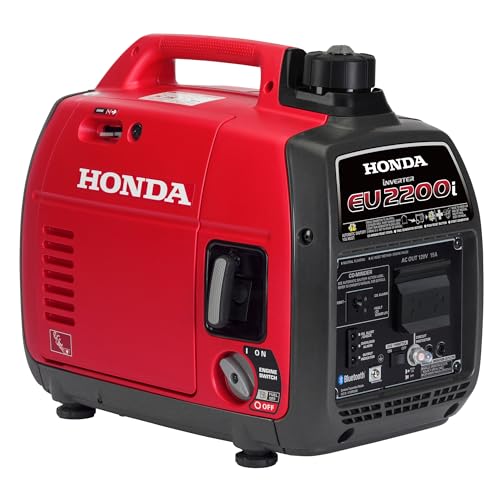
1. Honda EU2200i — Best Overall Generator for Mobile Detailing
The Honda EU2200i is the benchmark. Full stop. It’s the generator detailers recommend most, and the specs back that up for daily professional use.
Key Features
- 2,200 surge watts / 1,800 running watts — handles vacuum, lights, and chargers together
- 48–57 dB(A) operating range — genuinely quiet in residential driveways
- Eco-throttle mode adjusts fuel use to actual load, stretching runtime
- Parallel capability lets you link two units for double the power when needed
- Weighs just 47.4 lbs — solo-loadable into any van or truck
Pros and Cons
Pros
- Exceptionally quiet — clients rarely notice it running nearby
- Inverter output protects sensitive detailing electronics
- Honda reliability means fewer breakdowns on job days
- Fuel-efficient enough for full-day routes on a single tank
Cons
- 1,800 running watts limits use with air compressors over 1 HP
- Premium price point — highest upfront cost on this list
Pricing
Mid-to-high price tier; expect to pay a premium over comparable wattage alternatives.
Our Verdict
The EU2200i is the right call for detailers who prioritize quiet operation and daily reliability over raw power. If your kit is a vacuum, polisher, work lights, and chargers, this runs everything without complaint. Pair two in parallel if you grow into bigger tool loads.
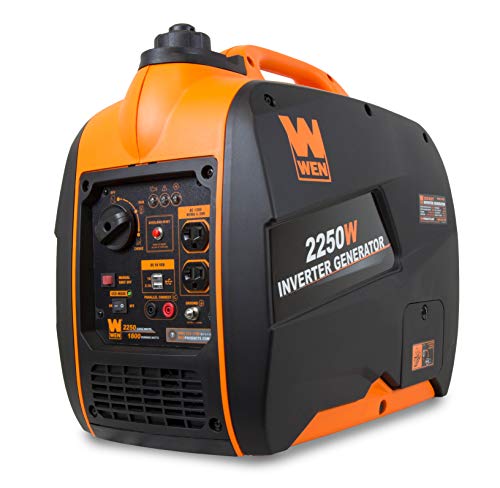
2. WEN 56200i — Best Budget Generator for Mobile Detailing
Budget doesn’t have to mean underpowered. The WEN 56200i hits a practical entry point for solo detailers building their first mobile kit without overspending on day one.
Key Features
- 2,000 surge watts / 1,600 running watts — covers vacuum and lighting simultaneously
- 51 dB(A) at quarter load — quieter than many pricier conventional units
- Clean inverter power output protects electronics and sensitive tools
- Compact design with a built-in carry handle for easy van loading
- Runs approximately 6 hours at half load on under a gallon of fuel
Pros and Cons
Pros
- Lowest price on this list — strong value for new detailers
- Quiet enough for suburban driveways and apartment parking
- Inverter output is clean and safe for polishers and chargers
- Lightweight at 48 lbs for frequent load-in and load-out
Cons
- 1,600 running watts leaves little headroom for adding tools
- Not rated for parallel use — can’t scale up without buying a different unit
Pricing
Entry-level price tier; among the most affordable inverter generators in this wattage class.
Our Verdict
The WEN 56200i suits new mobile detailers who run a shop vac, a detail light, and a charger — nothing more. Pair it with best car wheel brushes and hand-tool techniques to keep your draw low and your costs lower.

3. Champion 3500-Watt Dual Fuel — Best Dual-Fuel Generator for Longer Jobs
Long service days eat through fuel fast. The Champion 3500-Watt Dual Fuel solves that problem with gas-or-propane flexibility — a genuine advantage for busy detailers on multi-appointment routes.
Key Features
- 3,500 surge watts / 3,150 running watts — covers full mobile detailing loads confidently
- Runs on gasoline or propane — swap fuels based on availability and storage preference
- Up to 9 hours runtime on gas, longer on propane at light loads
- Electric start included — no pull-cord frustration at 7 AM
- 68 dB(A) operating noise — louder than inverter models, manageable in non-residential settings
Pros and Cons
Pros
- Dual-fuel flexibility reduces the risk of running dry mid-job
- 3,150 running watts handles compressors, vacuums, and lights together
- Electric start speeds up setup at each appointment
- Strong value for the wattage delivered compared to inverter alternatives
Cons
- Heavier than inverter units at around 119 lbs — needs a wheel kit
- Louder at 68 dB — not ideal for upscale residential driveways
Pricing
Mid-range price tier; delivers excellent wattage-per-dollar compared to inverter equivalents.
Our Verdict
This is the workhorse pick for detailers doing 4–6 appointments daily or running compressor-based systems. Propane also stores longer than gasoline, which matters if you’re between heavy-use weeks. Pair it with a good best water hose for car wash setup to round out your mobile rig.

4. Westinghouse iGen2200 — Best Quiet Generator for Residential Mobile Jobs
Quiet residential routes demand a different tool. The Westinghouse iGen2200 is built for exactly that — neighborhoods, gated communities, and client driveways where noise is noticed.
Key Features
- 2,200 surge watts / 1,800 running watts — matches the Honda EU2200i in output
- 52 dB(A) at quarter load — one of the quietest units at this power level
- Eco-mode engages automatically to reduce noise and fuel draw at lighter loads
- Parallel-ready with compatible Westinghouse units for future expansion
- 12-hour runtime at quarter load — handles long residential day routes
Pros and Cons
Pros
- Quieter than most competitors at similar wattage — neighbor-friendly
- Clean inverter power safe for all detailing electronics
- 12-hour runtime at light load means no mid-day refueling on most routes
- More affordable than Honda at comparable specs
Cons
- 1,800 running watts limits heavier compressor use
- Parallel cable sold separately — add-on cost for expanded power
Pricing
Mid-range price tier; priced below Honda EU2200i for similar running watts and noise output.
Our Verdict
The iGen2200 is the quietest dollar-for-dollar option for detailers working residential routes daily. Pair it with best microfiber towels for car detailing for a quiet, finishing-focused workflow that keeps clients and neighbors happy.

5. DuroMax XP5500EH — Best High-Power Generator for Vacuums and Wash Equipment
Some setups need more. Running a wet/dry vacuum, a pressure washer, an air compressor, and work lights simultaneously pushes past the 3,500-watt mark. The DuroMax XP5500EH is built for that kind of load.
Key Features
- 5,500 surge watts / 4,500 running watts — handles the heaviest detailing loads
- Dual-fuel capable — runs on gas or propane for fuel flexibility on big job days
- Electric start with remote capability — reduces physical effort during heavy setups
- 4 120V outlets plus a 240V connection for diverse equipment configurations
- Runs approximately 8.5 hours at half load on a full gas tank
Pros and Cons
Pros
- 4,500 running watts supports multiple high-draw tools without tripping
- Dual-fuel design reduces refueling stress on long-day commercial jobs
- Multiple outlets support full rig operation without splitters
- Strong long-term reliability in professional-use feedback
Cons
- Weighs 130 lbs — requires a trailer or dedicated cargo space
- Louder than inverter units — not suited for quiet residential neighborhoods
- Conventional generator power — not ideal for highly sensitive electronics
Pricing
Upper-mid price tier; strong wattage-per-dollar for the power class delivered.
Our Verdict
This is the right choice for detailers running best pressure washers for cars alongside vacuums, compressors, and lighting at the same time. Also pair it with a quality best pressure washer gun for car detailing to maximize your wash setup’s efficiency. It’s not portable in the carry-and-go sense — it’s a rig generator for serious mobile operations.
How to Size a Generator for Your Detailing Setup
Start with your tools. List every piece of equipment you run at one time. Here’s a realistic example:
| Tool | Running Watts | Surge Watts |
|---|---|---|
| Wet/dry shop vac (6 gallon) | 900W | 1,800W |
| LED work lights (2× 100W) | 200W | 200W |
| Phone/tablet charger | 50W | 50W |
| Random orbital polisher | 600W | 800W |
| Total | 1,750W | 2,850W |
That load fits a 2,200W inverter unit with headroom. Add an air compressor (1,500–2,000W running) and you’re crossing into 3,200W territory — exactly where the detailing community’s practical baseline sits.
The formula is simple. Add running watts for all simultaneous tools. Then confirm your surge watts cover the highest single startup spike. Add a 20% safety margin on top. That’s your real minimum.
Deciding between a gas vs electric pressure washer for cars also changes your generator math significantly. Electric pressure washers typically draw 1,500–1,800W running. Gas pressure washers need zero generator power — a real load reduction worth considering for off-grid setups.
If you’re off-grid on water too, reviewing best water tanks for car detailing helps you plan your full system, not just the electrical side.
Always look at best air blowers for car detailing wattage too. Electric blowers add 1,000–1,500W to your draw — a significant factor for sizing.
Final Verdict: Which Generator Is Best for Most Mobile Detailers?
Most solo mobile detailers should start with the Honda EU2200i or the Westinghouse iGen2200. Both deliver reliable inverter power, quiet operation, and enough wattage for a vacuum, polisher, lights, and chargers in one setup.
Detailers running compressors and pressure washers simultaneously should step up to the Champion 3500 Dual Fuel or the DuroMax XP5500EH. Budget starters do well with the WEN 56200i while building their kit.
The right generator matches your actual tool list — not a generic target. Build your load table, check your surge numbers, add your margin, and buy accordingly.
Explore more about building a complete car detailing operation from the ground up.