Best Pressure Washer Nozzle for Car Washing: 6 Top Picks (Safe & Effective)

The wrong nozzle will strip your clear coat in seconds. That’s not an exaggeration — a zero-degree tip can etch paint, tear through protective wax, and leave permanent marks with a single pass. Choosing the right pressure washer nozzle for car washing is the single most important decision you’ll make before pointing that gun at your vehicle.
Most guides stop at “use the white 40-degree nozzle.” That’s correct — but incomplete. Different stages of a wash require different nozzles, and some machines run too hot even for a 40-degree tip. This guide covers all six nozzle types you need to know, including one specialty option most car owners have never heard of.



How to Choose the Right Nozzle for Your Car
Two numbers determine whether you damage your paint or clean it safely: PSI and spray angle.
The recommended PSI range for vehicles sits between 1,000 and 1,800. Go above 2,000 PSI without the right nozzle, and you’re risking clear coat damage on every pass. Our full water pressure for car wash guide breaks down the safe thresholds by surface type.
Spray angle is equally critical. A 0-degree nozzle concentrates all that pressure into a pencil-thin stream. A 40-degree nozzle spreads it across a wide fan — dramatically reducing the force hitting any single point of paint. Wider always means safer for bodywork.
Distance matters too. Stay 12 to 24 inches from the surface at all times. Closing that gap even slightly multiplies the effective PSI on contact. Think of it like a garden hose: the closer you hold it, the harder the water hits.
Understanding the difference between gas vs electric pressure washer for cars also affects which nozzle you need — gas units typically run higher PSI and demand wider angles. Check our power washer vs pressure washer for cars comparison if you’re unsure what machine you own.
Quick nozzle safety rules:
- Always start with the widest nozzle available
- Test on a hidden panel before full use
- Never use a red or yellow nozzle on paint
- Match nozzle angle to your machine’s PSI output
1. White 40-Degree Nozzle — Best Overall for Car Washing
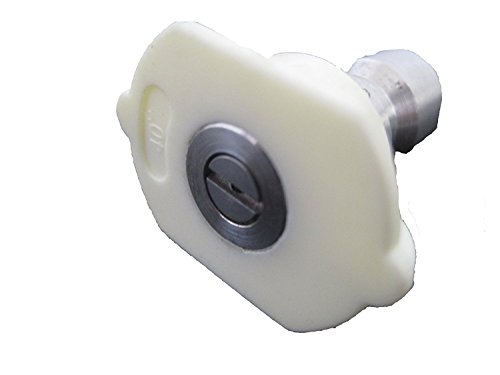
The white 40-degree nozzle is the definitive answer to “which tip should I use on my car?” It delivers the ideal balance of cleaning power and paint safety, making it the right choice for general washing and final rinsing on virtually any vehicle.
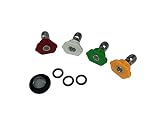
The wide 40-degree fan spread reduces the impact force at the paint surface without sacrificing cleaning ability. You’ll remove road grime, light mud, and dust effectively while keeping the clear coat intact. The standard nozzle color and angle chart confirms white as the universal recommendation for vehicle surfaces.
For guidance on what color nozzle to pressure wash a car, white is the consistent answer across detailing professionals and equipment manufacturers alike.
Key Features
- 40-degree spray fan spreads pressure safely across paint surfaces
- Works on 1,000–2,000 PSI machines without paint risk
- Handles both washing and final rinse stages in one nozzle
Pros and Cons
Pros
- Widest safe spray angle for general car bodywork cleaning
- Effective on most dirt types without stripping wax or sealant
- Available in universal quick-connect for most pressure washers
Cons
- May feel underpowered on very low PSI machines under 1,200
- Not suitable for applying soap or detergent solutions
Pricing
White 40-degree nozzles are budget-friendly, typically in the $8–$20 range for quality brass options.
Our Verdict
This is the nozzle you start with. It’s the safest general-purpose tip for car paint, and it handles 80% of your washing needs. If you only buy one nozzle, make it this one.
2. Black 65-Degree Nozzle — Best for Soap Application
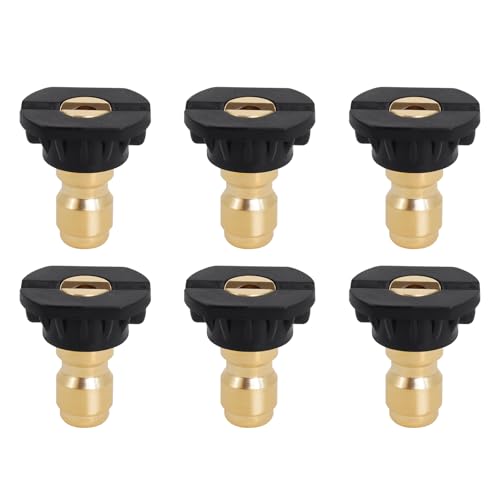
Don’t skip this one. The black 65-degree nozzle is non-negotiable if you’re using a pressure washer detergent system or foam cannon adapter.
It delivers a wide, low-velocity spray designed specifically for applying soap. The ultra-wide 65-degree angle reduces pressure to near zero — enough to coat the car in foam but nowhere near enough to harm paint. It’s the starting point for every two-bucket wash method done with a pressure washer.
The black nozzle works by increasing flow volume while dropping pressure. You get a generous, even soap application across large panels without any streaking or uneven coverage. Pair it with a quality car wash soap for hard water for the best pre-soak results.
Key Features
- 65-degree spray angle for maximum low-pressure soap coverage
- Activates built-in detergent systems on most pressure washers
- Prevents soap from drying before you rinse — critical in warm weather
Pros and Cons
Pros
- Zero paint damage risk at this angle and pressure level
- Ensures even, thick foam application across entire panels
- Essential for activating detergent tanks on consumer pressure washers
Cons
- Only for soap — never use for rinsing or washing
- Won’t remove stuck-on dirt without follow-up scrubbing
Pricing
Black nozzles are among the most affordable tips, typically under $15 for individual units.
Our Verdict
Buy this alongside the white 40-degree tip. You need the black nozzle first to pre-soak the car properly, then switch to white for the wash. Using them together produces far cleaner results than either alone.
3. Specialty Low-PSI Shower Nozzle — Best for Safety on High-PSI Machines
This is the one most detailers don’t know about. It’s genuinely worth your attention.
If your pressure washer runs above 2,000 PSI, even a 40-degree white nozzle carries risk on delicate paintwork, older vehicles, or fresh paint jobs. Specialty low-PSI shower nozzles — sometimes called “Kev nozzles” in the detailing community — solve this by reducing output pressure while actually increasing water flow (GPM). The result is a gentler, shower-like spray that dislodges dirt through volume rather than force.
These nozzles flip the conventional equation. Standard tips reduce GPM to increase PSI. Shower nozzles do the opposite — higher GPM, lower PSI — which is exactly what sensitive paint surfaces need.
Key Features
- Reduces PSI output on high-powered machines while increasing water flow
- Shower-pattern spray removes dirt through volume, not pressure
- Ideal for older paint, vinyl wraps, or freshly detailed surfaces
Pros and Cons
Pros
- Maximum paint safety on machines rated above 2,000 PSI
- Effective at rinsing without risk of clear coat damage
- Useful on delicate areas like mirrors, door handles, and trim
Cons
- Harder to source — available through specialist detailing suppliers
- Higher GPM means more water consumption per wash session
Pricing
Specialty shower nozzles sit in the mid-range — typically $25–$50 depending on brand and connection type.
Our Verdict
If you own a high-PSI gas pressure washer and you’re worried about paint, this nozzle is your best insurance. The investment is small relative to the cost of fixing paint chips caused by the wrong nozzle.
4. Green 25-Degree Nozzle — Best for Targeted Rinsing on Low-PSI Units
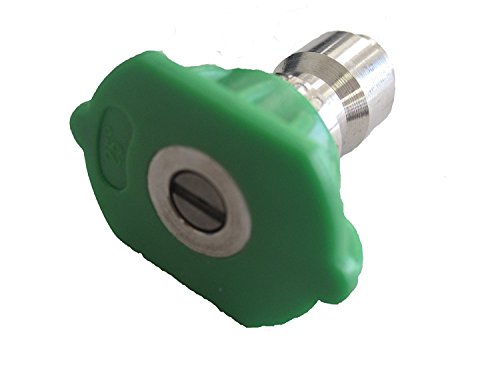
The green 25-degree nozzle sits between the white and yellow tips. It’s more focused than 40 degrees but far safer than 15. It’s not the default car washing nozzle — but it serves a specific purpose well.
On a low-spec electric washer running 1,000–1,200 PSI, the 40-degree white tip can feel underpowered against heavier road grime. The green 25-degree narrows the spray slightly, adding enough force to cut through stubborn soap residue and dirty rinse water without crossing into risky territory.
Use it only on low-to-mid PSI machines. It’s also effective for wheel arches and undercarriage areas where the paint risk is lower and the dirt load is higher.
Key Features
- 25-degree spray angle focuses pressure for better grime removal on low-PSI machines
- More surface coverage than yellow but more targeted than white
- Effective for wheel wells and lower body panels
Pros and Cons
Pros
- Good performance on stubborn soap film with machines under 1,500 PSI
- Safer than yellow for door panels and bonnet surfaces
- Works well for car wheel brushes pre-rinse before scrubbing
Cons
- Not safe to use on high-PSI units above 2,000
- Too narrow for large panel rinsing — slower than a 40-degree tip
Pricing
Green 25-degree nozzles are budget-friendly, generally in the $8–$18 range.
Our Verdict
A useful secondary nozzle for low-PSI electric washers struggling to shift heavy grime. Don’t use it as your primary wash tip — reserve it for wheel arches and problem areas only.
5 & 6. Red (0°) and Yellow (15°) Nozzles — Nozzles to AVOID on Cars
Stop. Don’t use these. Ever.
The red 0-degree nozzle concentrates the full pressure of your machine into a single pencil-thin stream. At 1,500 PSI, that stream hits a surface like a metal spike. It will etch paint, cut through clear coat, strip wax instantly, and leave visible damage in a single slow pass. There is no scenario where this nozzle belongs near a vehicle’s painted surface.
The yellow 15-degree nozzle is almost as dangerous. At 15 degrees, the spray is still concentrated enough to cause clear coat damage at normal washing distances — especially on machines running above 1,500 PSI. Some detailers use it on concrete or heavily stained driveways. It has no place in your car washing routine.
Both nozzles are appropriate for industrial cleaning tasks: stripping paint from metal, cleaning engines from a safe distance, or blasting mud off plant equipment. That’s it.
If you’ve already used a red or yellow nozzle on your car, check for paint etching and swirl marks. Our guide on how to buff out scratches on a car walks through the repair process step by step. You may also need to polish out car scratches if the damage cut below the clear coat surface.
Pros and Cons
Pros
- Effective for industrial, non-vehicle surfaces
- Red 0° excels at stripping stubborn deposits from concrete
Cons
- Permanently damages car paint clear coat at normal washing distances
- Yellow 15° causes etching on bonnet and roof panels within seconds
- No safe application distance exists for painted car surfaces
Pricing
These nozzles are cheap — often under $10. The repair bill they cause is not.
Our Verdict
Mark them with tape. Store them separately. These nozzles are useful tools — but never for your car.
Buying Guide: Nozzle Types & Pressure Washer Compatibility
Choosing the right nozzle also means choosing the right build quality and connector type. Not all nozzles are equal.
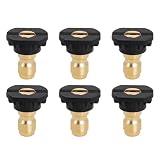
Material: Brass nozzles outlast plastic by years. Brass resists heat, corrosion, and UV exposure. Plastic nozzles are fine for occasional use but degrade quickly under regular pressure. For consistent car washing, spend a few extra dollars on brass.
Connection type: Most consumer pressure washers use a quick-connect system — a simple twist-lock collar that allows fast nozzle swaps mid-wash. Threaded connections are more secure but slower to change. Always confirm your washer’s connector type before buying nozzles.
PSI rating: Every nozzle carries a maximum PSI rating. Match it to your machine. A nozzle rated for 2,500 PSI will handle anything in the consumer range. Check a full pressure washer nozzles chart to match angle, color, and PSI rating before buying.
For precision spray pattern nozzles used by professional detailers, Griots Garage produces quality options built specifically for vehicle surfaces. Their BOSS nozzle line balances controlled output with durability.
For more gear recommendations, our guides to the best pressure washer gun for car detailing and best water hose for car wash cover everything else you’ll need for a complete setup. You may also want the Westinghouse ePX3500 electric pressure washer if you’re looking for a car-safe machine that runs at a sensible PSI.
Compatibility quick-reference:
| Nozzle Color | Angle | Best Use | PSI Safety |
|---|---|---|---|
| Red | 0° | Industrial only | Never on cars |
| Yellow | 15° | Concrete, driveways | Never on cars |
| Green | 25° | Low-PSI car rinse | Below 1,500 PSI only |
| White | 40° | Car washing & rinsing | Up to 2,000 PSI |
| Black | 65° | Soap application | Any PSI machine |
| Specialty | Shower | High-PSI safety | Above 2,000 PSI |
FAQ: Common Questions About Pressure Washer Nozzles
Can I use a 40-degree nozzle on a high-PSI washer?
Yes, but with caution. At 2,000–2,500 PSI, the 40-degree tip still carries meaningful force. Maintain the full 24-inch distance and keep moving constantly. For machines above 2,500 PSI, a specialty shower nozzle is the safer option.
What PSI is safe for washing a car?
1,000 to 1,800 PSI is the accepted safe range. Most electric pressure washers fall within this band. Gas-powered units often exceed 2,500 PSI and require either wider nozzles or reduced distance to stay safe.
Do I need a special nozzle for a foam cannon?
Yes. A foam cannon connects via a dedicated fitting and uses your machine’s pressure to create thick foam. Most foam cannons work best at 1,200–2,000 PSI and don’t use standard color-coded nozzles — they have their own adjustable spray head. After rinsing foam, switch to your white 40-degree nozzle for the main wash.
Will water spots form after pressure washing?
They can. Hard water leaves mineral deposits on paint as it dries. After washing, dry the car immediately with quality microfiber towels for car detailing to prevent spots. For prevention and removal techniques, check our guide on car water spots causes, prevention, and removal.
Conclusion
The white 40-degree nozzle wins. It’s the right choice for 90% of car washing situations and the safest tip for painted surfaces. Pair it with the black 65-degree nozzle for soap application, and you’ve covered every stage of a standard wash.
If you own a high-PSI machine above 2,000, look into specialty shower nozzles. They deliver the safety margin that even a white nozzle can’t provide at extreme pressures.
Red and yellow nozzles stay in the box — or better yet, out of your car washing kit entirely.
For everything you need to complete the setup, our guide to the best pressure washers for cars covers the full machine side of the equation. The right nozzle on the wrong machine still causes damage. Match both carefully, and your paint will thank you.