Best Water Tanks for Mobile Detailing: 7 Picks for Capacity, Durability, and Easy Setup

Choosing the wrong water tank can wreck your whole day. Too small and you’re making extra refill trips. Too heavy and you’re exceeding your van’s payload before you’ve even loaded your chemicals.
This guide cuts through the confusion. We’ve matched seven tanks to specific operator types, so you can identify the right pick fast — whether you’re just starting out or running a full-time route.


What to Look for in a Mobile Detailing Water Tank
Getting this decision right starts with understanding four things: capacity, weight, material, and pump fit. Skip any one of them and you’ll regret it.
How Much Water Does Mobile Detailing Use?
Water use varies by service type. A quick maintenance wash uses roughly 10–15 gallons per car. A full detail with wheel cleaning, pre-rinse, and multiple rinse stages can push 20–30 gallons.
If you’re doing 4–5 cars daily, a 65-gallon tank covers a full day without refilling. Knowing how many gallons of water to wash a car helps you calculate this before you buy anything.
Why Tank Weight Changes Everything
Water weighs 8.34 lbs per gallon. A full 65-gallon tank adds 542 lbs. A full 100-gallon tank adds 834 lbs — before you count tools, chemicals, or the tank itself.
That math matters a lot. Check your vehicle’s Gross Vehicle Weight Rating (GVWR) and subtract curb weight plus equipment before committing to a size.
Best Tank Materials for Durability
UV-stabilized polyethylene is the standard for outdoor water storage tanks. It resists cracking from sun exposure, handles temperature swings, and holds up to road vibration far better than plain plastic.
Look for tanks meeting ASTM material standards for polyethylene construction. For water that touches your car’s paint, also check whether the tank meets food-grade material guidance. Food-grade materials don’t leach chemicals into stored water, which protects both your wash quality and your customers’ paint.
Baffles matter too. Internal baffles reduce water slosh while driving, keeping your van stable on corners and reducing stress on tank walls. Understanding car cleaning water quality science also helps — hard water stored in certain tanks can deposit scale faster, affecting your rinse results and contributing to car water spots. Water pressure for car wash output depends partly on tank design and pump setup, so treat all three as a system.
1. Norwesco 65-Gallon Vertical Tank — Best Overall
The Norwesco 65-gallon vertical polyethylene tank is the workhorse pick for solo mobile detailers. It hits the practical sweet spot between capacity, manageable weight, and van-friendly dimensions.
Key Features
- UV-stabilized polyethylene resists sun damage during outdoor storage and transport
- Vertical design fits neatly behind van wheel wells without blocking cargo floor
- Standard 2-inch threaded outlet fits most common pump and hose fittings
- Translucent sidewall lets you check water level without a gauge
Pros and Cons
Pros
- Handles 3–5 standard maintenance washes before needing a refill
- Lightweight empty (around 22 lbs) makes solo loading manageable
- Wide-mouth lid allows easy interior cleaning and chemical flushing
- Affordable entry price relative to tank quality and brand reputation
Cons
- Vertical profile needs secure strapping to prevent tipping in cargo areas
- No built-in baffles in base model, so slosh can occur at highway speeds
Pricing
Mid-range pricing. Widely available from agricultural and industrial supply retailers.
Our Verdict
The Norwesco 65-gallon is the right first tank for most solo detailers. It’s a trusted pick in the broader best water tanks for car detailing category and a practical baseline for any mobile setup. Choose it if you’re doing 4–6 cars per day and want reliability without overspending.
2. Snyder Industries 50-Gallon Flat-Bottom Tank — Best Budget Pick
Starting out? This is the one. Snyder’s 50-gallon flat-bottom polyethylene tank keeps cost low while delivering the core durability a mobile detailer needs.
Key Features
- Flat-bottom design sits stable on van floors without custom brackets
- FDA-compliant food-grade resin keeps stored water clean for paint-safe rinsing
- Standard threaded outlet ports work with basic pump setups right out of the box
- Compact footprint fits comfortably in smaller transit vans and pickup beds
Pros and Cons
Pros
- Lower purchase price than comparable tanks from premium brands
- Food-grade compliance adds water quality confidence for new operators
- Compact size reduces payload strain on light-duty vehicles
- Easy to find locally at farm supply or hardware retailers
Cons
- 50-gallon limit means refill stops after 3–4 cars on full detail jobs
- Lighter wall thickness compared to roto-molded heavy-duty alternatives
Pricing
Budget-friendly. One of the lowest entry points among quality polyethylene detailing tanks.
Our Verdict
The Snyder 50-gallon makes sense for part-time detailers or anyone testing the waters before scaling up. It won’t last forever under daily abuse, but it gets you operational fast and keeps startup costs manageable. Step up when your route grows.
3. Chem-Tainer 50-Gallon Low-Profile Tank — Best for Compact Vans
Tight on cargo space? This tank was designed for exactly that situation. Chem-Tainer’s low-profile 50-gallon unit sits closer to the van floor, lowering the center of gravity and keeping your load stable.
Key Features
- Low-profile rectangular shape fits under shelving or behind equipment racks
- UV-stabilized linear polyethylene handles outdoor storage without brittleness
- Multiple outlet positions allow flexible plumbing to match different van layouts
- Smooth interior walls minimize sediment buildup between deep cleans
Pros and Cons
Pros
- Low center of gravity improves van stability when tank is fully loaded
- Rectangular footprint maximizes floor space efficiency in compact cargo areas
- Multiple outlet options simplify pump positioning and hose routing
- Brand reputation strong in commercial and detailing markets
Cons
- Low profile means shorter fill access — a fill pump or extension may help
- 50-gallon max limits use on high-volume days without a midday refill
Pricing
Mid-range. Priced slightly above basic options due to the specialized form factor.
Our Verdict
The Chem-Tainer low-profile tank is the smart pick for Ford Transit, Ram ProMaster, or Mercedes Sprinter operators with built-out cargo floors. If cargo height is your biggest constraint, this solves it cleanly without sacrificing durability.
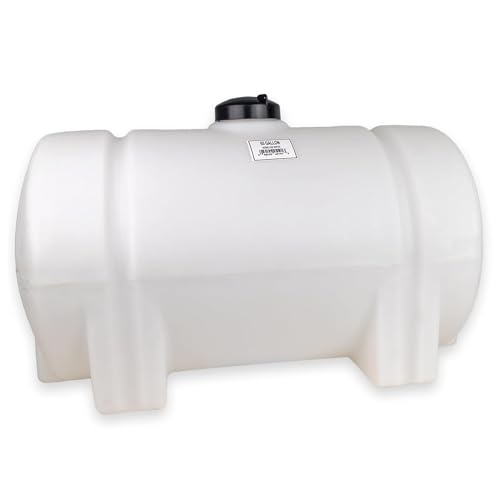
4. Norwesco 65-Gallon Horizontal Leg Tank — Best for Solo Operators
This is a different animal from the vertical Norwesco. The horizontal leg tank mounts flat and low, offering exceptional stability — a real advantage when you’re driving loaded roads all day.
Key Features
- Horizontal orientation distributes water weight low and wide for better road stability
- Integrated legs bolt directly to van floor or trailer deck without extra brackets
- Internal baffles reduce water movement during acceleration and cornering
- 2-inch threaded outlet and top fill port match standard detailing plumbing specs
Pros and Cons
Pros
- Baffled design noticeably reduces slosh on uneven roads and sharp turns
- Integrated mounting legs simplify installation for solo builders
- Stable low-mounted position protects your van’s center of gravity under load
- 65-gallon capacity handles a full solo operator day without refilling
Cons
- Horizontal profile takes up more van floor length than a vertical tank
- Heavier empty weight (approximately 28 lbs) due to leg structure
Pricing
Mid-range to slightly above. The integrated leg system adds modest cost over basic vertical models.
Our Verdict
Choose the Norwesco horizontal leg tank if you drive a lot between jobs or work areas with rough roads. The baffled, low-mounted design genuinely reduces slosh fatigue and keeps your load from shifting. Best for full-time solo operators who prioritize stability over compactness.
5. Norwesco 100-Gallon Vertical Tank — Best for Higher-Volume Work
More cars, more water. Simple. The Norwesco 100-gallon vertical tank is built for detailers running 8–10 cars daily or targeting fleet accounts.
Key Features
- 100-gallon capacity supports 6–8 full maintenance washes without refilling
- UV-stabilized polyethylene holds up through daily sun exposure in open trailer use
- Heavy-duty 2-inch outlet handles high-flow pump draws without pressure drop
- Wide fill port (16-inch diameter) speeds up refill time between routes
Pros and Cons
Pros
- Cuts midday refill stops on high-volume routes, saving 30–60 minutes daily
- Standard vertical profile fits trailer tongue boxes or enclosed trailer walls
- Wide-mouth access makes interior cleaning and inspection quick and easy
- Durable enough for full-time commercial use across multiple seasons
Cons
- Full weight exceeds 834 lbs — requires careful GVWR calculation before buying
- Taller profile needs heavy-duty strapping and solid mount points to stay secure
Pricing
Upper mid-range. Larger capacity commands a proportional price increase over 65-gallon models.
Our Verdict
The 100-gallon Norwesco is best for detailers running trailers or full-size cargo vans with confirmed payload headroom. Don’t guess on GVWR. If your vehicle can handle the weight safely, this tank eliminates the single biggest daily frustration of water refill trips.
6. Ronco Plastics Heavy-Duty 65-Gallon Roto-Molded Tank — Best for Durability
Roto-molded tanks aren’t the same as standard blow-molded polyethylene. Ronco builds this 65-gallon unit with uniform wall thickness throughout, which means no weak points at seams or corners.
Key Features
- Roto-molded construction eliminates seam weak points found in standard tanks
- High-density polyethylene withstands impact, UV exposure, and chemical splash
- Reinforced outlet boss prevents cracking under pump vibration and torque
- Smooth rounded interior shape makes complete draining and cleaning straightforward
Pros and Cons
Pros
- Roto-mold process produces a single-piece shell with no weld or seam failures
- Handles road vibration and load shifting better than standard molded alternatives
- Reinforced plumbing connections reduce leak risk over years of daily use
- Long service life justifies higher upfront cost for full-time operators
Cons
- Higher purchase price than standard polyethylene tanks of equal capacity
- Heavier empty weight may reduce net payload compared to lighter alternatives
Pricing
Premium tier. Roto-molded construction costs more upfront but lasts significantly longer.
Our Verdict
If you’re running a full-time detailing business and need your equipment to survive years of daily use, the Ronco roto-molded tank earns its price. The construction quality is genuinely different. Choose it when longevity matters more than upfront savings.
7. Snyder Industries 35-Gallon Utility Tank — Best for Easy Pump Integration
This pick is about workflow, not just capacity. The Snyder 35-gallon utility tank is built with plumbing in mind — multiple outlet positions, a clean interior, and dimensions that pair naturally with 12V submersible pump setups common in mobile detailing rigs.
Key Features
- Multiple factory outlet ports simplify direct pump mounting without extra fittings
- Compact 35-gallon size works for waterless-assist or rinse-water-only rigs
- Smooth interior walls reduce pump intake blockage from sediment buildup
- Compatible with common 12V pump systems used in van-based detailing setups
Pros and Cons
Pros
- Multiple pre-drilled outlet options reduce custom plumbing fabrication time
- Compact size pairs cleanly with gravity-feed or low-pressure submersible setups
- Easy to source replacement fittings due to standard outlet thread sizes
- Low empty weight makes repositioning and reinstalling quick for solo operators
Cons
- 35-gallon limit means this works best as a secondary or rinse-only tank
- Not suited as the primary tank for full-service detailing without a second unit
Pricing
Budget to mid-range. One of the most affordable options with solid plumbing flexibility.
Our Verdict
The Snyder 35-gallon utility tank shines as a dedicated rinse or pump-feed tank in a dual-tank setup. For gas vs electric pressure washer for cars users, it’s worth understanding the difference in flow demand before selecting your pump. See pump compatibility documentation to match your pump draw to tank outlet sizing. Understanding the power washer vs pressure washer distinction also matters here — flow rate requirements differ significantly between the two. Pair it with the right best pressure washer gun for car detailing and you’ve got a clean, lightweight rig that stays simple. Add best water deionizers for car washing inline for spot-free results.
Quick Comparison: All 7 Tanks at a Glance
| Tank | Capacity | Best For | Key Advantage |
|---|---|---|---|
| Norwesco 65-Gal Vertical | 65 gallons | Solo operators — best overall | Balanced size, weight, and price |
| Snyder 50-Gal Flat-Bottom | 50 gallons | Budget startups | Low cost, food-grade compliance |
| Chem-Tainer 50-Gal Low-Profile | 50 gallons | Compact vans | Space-efficient rectangular shape |
| Norwesco 65-Gal Horizontal Leg | 65 gallons | Stability-focused solo ops | Baffled, low-mounted, stable |
| Norwesco 100-Gal Vertical | 100 gallons | High-volume / fleet work | Maximum daily capacity |
| Ronco 65-Gal Roto-Molded | 65 gallons | Full-time durability | Seamless roto-molded build |
| Snyder 35-Gal Utility | 35 gallons | Pump integration / secondary | Multi-port plumbing flexibility |
How to Choose the Right Tank Size for Your Mobile Detailing Business
Don’t just pick the biggest tank you can fit. Match the tank to your actual daily volume and vehicle limits.
How Many Gallons Per Car?
Use 15 gallons per car as your planning baseline. Maintenance washes run 10–12 gallons. Full details with wheel cleaning, pre-wash, and final rinse push 20–25 gallons. Build your estimate around your actual service menu.
For water conservation context, reviewing water efficiency basics from the EPA can help you tighten your rinsing process — less water wasted means more capacity per tank load.
Payload Checklist Before Buying
Work through this before placing any order:
- Find your GVWR — check the door jamb sticker or owner’s manual
- Subtract curb weight — this is your max payload
- Subtract equipment weight — pressure washer, chemicals, hoses, tools
- Calculate full tank weight — gallons × 8.34 lbs
- Check remaining margin — keep at least 100 lbs of safety buffer
The vehicle weight rating guidance from FMCSA explains how payload limits apply to commercial vehicle operators. Exceeding GVWR isn’t just a legal risk — it affects braking distance, tire wear, and accident liability.
| Daily Cars | Recommended Tank | Full Tank Weight |
|---|---|---|
| 2–3 cars | 35–50 gallons | 292–417 lbs |
| 4–5 cars | 65 gallons | 542 lbs |
| 6–8 cars | 80–100 gallons | 668–834 lbs |
| 8+ cars / fleet | 100 gallons + trailer | 834 lbs+ |
Space matters as much as weight. Measure your cargo area height, length, and floor width before buying. A tank that doesn’t fit securely is more dangerous than one that’s slightly smaller.
Connecting your tank setup to a broader detailing business plan helps too — equipment decisions ripple into pricing, scheduling, and vehicle costs.
Final Verdict: Which Water Tank Is Best for Most Mobile Detailers?
The Norwesco 65-gallon vertical tank is the right call for the majority of solo mobile detailers. It delivers practical daily capacity, handles standard pump setups without modification, and fits most transit van configurations without custom work.
Here’s the fast decision guide:
- Starting out or tight on budget? → Snyder 50-gallon flat-bottom
- Running a compact van with limited height? → Chem-Tainer 50-gallon low-profile
- Drive rough roads or long routes? → Norwesco 65-gallon horizontal leg
- Doing 8+ cars daily or fleet accounts? → Norwesco 100-gallon vertical
- Need maximum long-term durability? → Ronco 65-gallon roto-molded
- Building a pump-integrated or dual-tank rig? → Snyder 35-gallon utility
Pick the tank that matches your vehicle, your route, and your daily volume. Get that right and everything else in your mobile setup becomes easier to build around it.