Pressure Washer Nozzles Chart: Colors, Angles, and Uses

Picking the wrong pressure washer nozzle can strip paint, damage wood, or leave a driveway still dirty. The good news: the color-coded system makes selection fast once you know what each tip does. This guide gives you a quick reference chart, plain-English sizing advice, and a task-by-task nozzle picker.
Pressure Washer Nozzle Color Chart at a Glance
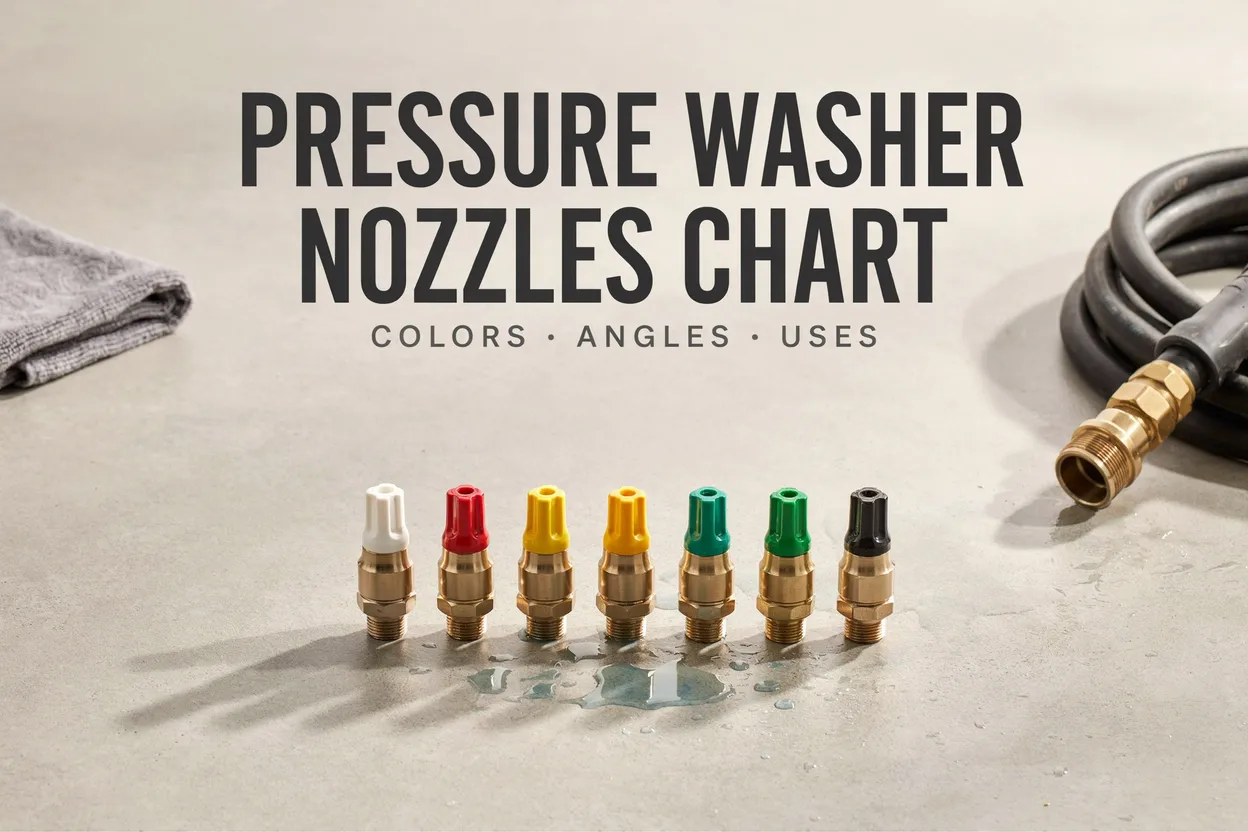
Every standard pressure washer comes with color-coded tips. Each color signals a spray angle — and that angle determines how concentrated the water pressure is.
If you’re comparing best high pressure water guns for car washing, understanding nozzle angles matters just as much as PSI ratings.
| Color | Spray Angle | Pressure Level | Best For |
|---|---|---|---|
| Red | 0° | Extreme | Rust removal, stubborn stains on concrete |
| Yellow | 15° | Very high | Stripping paint, heavy grime on hard surfaces |
| Green | 25° | Medium-high | General cleaning, driveways, decks |
| White | 40° | Gentle | Delicate surfaces, windows, siding |
| Black | 65° | Very low | Detergent application only |
| Turbo/Rotary | 0° rotating | High (pulsed) | Stubborn stains with wider coverage |
This chart is a starting point. Always test on a hidden area first.
What Each Pressure Washer Nozzle Color Means
Color isn’t just cosmetic. It encodes the spray angle, which directly controls how much pressure hits the surface.
For a deeper breakdown, see this pressure washer nozzle color guide from a manufacturer, or read pressure washer nozzles demystified for a clear overview of spray patterns and types.
Red 0° Nozzle
This is the most powerful tip. It fires a pencil-thin stream. Use it only on concrete or metal, never on wood, paint, or vehicles.
Yellow 15° Nozzle
Yellow is for tough jobs. It strips caked mud from wheels, removes mildew from concrete, and blasts heavy grease off garage floors. Keep it moving — holding it still can score soft surfaces.
Green 25° Nozzle
This is the most versatile nozzle. It handles most cleaning jobs around the house. Use green for driveways, patios, and garden furniture.
White 40° Nozzle
White spreads pressure across a wider area. It’s the go-to for rinsing cars, washing siding, and cleaning windows. The force is there — just distributed safely.
Black Soap Nozzle
The black tip runs at very low pressure. It’s designed only for applying detergent. High pressure actually prevents soap from drawing through the system, so switch to black for suds, then swap back for rinsing.
How to Match the Right Nozzle to PSI and GPM
Nozzle color tells you the angle. Orifice size tells you the flow. Getting the orifice wrong for your machine reduces cleaning power — or damages it. For full sizing reference, check this pressure washer nozzle chart from Dultmeier.
PSI vs. GPM Basics
PSI (pounds per square inch) measures water force. GPM (gallons per minute) measures flow volume. Both affect how a nozzle performs.
A 2,000 PSI / 2.0 GPM machine needs a different orifice than a 3,200 PSI / 2.5 GPM unit. Using an undersized orifice builds back-pressure that strains the pump.
How to Read the Chart
Nozzle orifice size is stamped as a number — for example, “2505” means 25° spray angle, size 05 orifice. Larger numbers mean larger openings.
Match your PSI and GPM to the manufacturer’s nozzle sizing chart. Most charts are indexed by GPM across the top and PSI down the side.
Example: Choosing the Right Orifice Size
Say your electric washer runs at 1,800 PSI and 1.5 GPM. The correct orifice size is roughly 3.0 to 3.5 at that pressure. For a real-world example, the Fanttik pressure washer review shows how a compact unit’s nozzles are sized to its specs. Similarly, the Ryobi 1.8 GPM pressure washer review shows how a mid-range flow rate guides tip selection.
Best Nozzle for Common Cleaning Jobs
Matching nozzle to task saves time — and prevents damage. Before washing vehicles, check out picks for best pressure washers for cars to ensure your machine is car-safe. Also refer to choosing the proper nozzle for the task at hand and this complete pressure washer nozzle guide for expanded task-based advice.
| Cleaning Job | Recommended Nozzle | Notes |
|---|---|---|
| Car wash | White 40° | Stand 2–3 feet away |
| Driveway / concrete | Green 25° or Yellow 15° | Yellow for stubborn stains only |
| Vinyl siding | White 40° | Spray downward to avoid water intrusion |
| Wood deck | Green 25° | Move with the grain |
| Patio furniture | Green 25° | Test painted surfaces first |
| Applying soap | Black 65° | Switch to a rinse nozzle after |
Car Washing
White is the right choice. It’s gentle enough to protect paint. Start 3 feet away and move closer only if dirt remains.
Driveways and Concrete
Start with green 25°. Switch to yellow 15° for oil stains or deeply embedded grime. Never use red on concrete near landscaping.
Siding and Fences
White 40° is safest for vinyl siding. Use green for painted wood fences. Always spray downward — upward angles can push water under panels.
Decks and Painted Surfaces
Green 25° with the grain. Keep the nozzle moving. Lingering too long in one spot raises wood grain and leaves marks.
How to Avoid Surface Damage
Always start wide. Test the widest nozzle first on a hidden spot. Move closer gradually until dirt lifts.
Keep at least 12 inches of distance for most surfaces. Red and yellow nozzles require 2+ feet on anything other than bare concrete or steel.
Soft materials — wood, stucco, painted surfaces — are damaged easily. One pass with the wrong nozzle can cost more to repair than the cleaning was worth.
Quick Pressure Washer Nozzle Selection Tips
- Start with white or green and work narrower only if needed
- Use black only for detergent — never for rinsing
- Flush nozzles after each use to prevent clogging
- Replace worn nozzles when pressure drops or spray fans unevenly
- A nozzle cleaning needle clears most clogs in seconds
Pressure Washer Nozzle Chart FAQ
Which pressure washer nozzle is safest?
White 40° is the safest for most surfaces. It distributes pressure over a wide area. Use it as your default starting point.
What nozzle should I use to wash a car?
White 40°, always. Some detailers use a foam cannon with the black nozzle for pre-soak, then rinse with white. Never use red or yellow on vehicle paint.
Why is the soap nozzle black?
Black signals low pressure. High pressure prevents detergent from drawing through the system. The black 65° nozzle creates a gentle spray that lets soap flow correctly.