The Best Water Hose for Car Wash and Detailing: A Ultimate Buyer’s Guide 2026

The difference between a mediocre car wash and a truly spotless finish often comes down to one overlooked detail: your hose. Most people grab whatever sits on the hardware store shelf, then wonder why their car washing experience feels frustrating—kinks appearing the moment they turn their back, water pressure dropping halfway down the driveway, or worse, a hose that fails after a single season.
The right water hose transforms your car washing routine. It delivers consistent pressure, moves freely around your vehicle, and handles years of use without degrading. The wrong one wastes your time and money.
Finding the ideal hose for car detailing isn’t complicated once you understand what actually matters. This guide walks through the technical and practical factors that determine which hose will serve your needs best.




Understanding How Hose Diameter Affects Cleaning Power
When pressure washer experts compare hoses, diameter—measured in fractions of an inch—dominates the conversation. Most people don’t realize that this single variable controls water flow, pressure consistency, and handling difficulty.
The 1/4-inch hose represents the lightest option. It weighs significantly less than larger alternatives, making it ideal if you’re washing cars frequently or working as a mobile detailer. The tradeoff: water pressure drops more rapidly as it travels through the narrower tube. Over a 100-foot run with typical 3 GPM flow, you lose roughly 10-15 PSI per 100 feet.
The 3/8-inch hose sits at the opposite end. It moves substantially more water without pressure degradation. For the same 100-foot distance, pressure loss drops to approximately 3-5 PSI per 100 feet. This diameter handles hot water applications reliably, making it standard for pressure washer professionals. The disadvantage: weight becomes a real factor, with some 3/8-inch hoses weighing 50-70% more than lighter alternatives.
The 5/16-inch hose represents the practical middle ground that most car detailers choose. It balances the lightweight handling of a 1/4-inch hose with the pressure stability of a 3/8-inch option. Pressure loss sits around 7-8 PSI per 100 feet—negligible for typical residential car washing. This diameter works with standard pressure washers without dragging excessive weight around your vehicle.
The physics here matters because pressure loss compounds across distance. If your washer starts at 2,500 PSI and you run a 1/4-inch hose for 150 feet, you’re losing roughly 22-30 PSI, bringing you down to 2,470 PSI. That’s recoverable. But run a thinner hose at greater lengths, and pressure loss becomes noticeable when you’re trying to rinse stubborn dirt.
Material Matters: Rubber, Polyurethane, and PVC Compared
Three primary materials dominate the hose market, and each behaves differently under the specific demands of car washing.
Rubber hoses represent the traditional workhorse. Premium rubber formulations stay flexible even in cold temperatures—a critical advantage in northern climates. They handle abrasion without degrading, meaning rough surfaces won’t damage the exterior. The downside: rubber hoses are heavy, often weighing 15-25 pounds for a 50-foot length. They do kink, though quality rubber formulations resist kinking better than PVC alternatives. Once kinked, rubber hoses sometimes retain that “kink memory,” making the same spot vulnerable to future problems.
Polyurethane hoses feature a different material structure that addresses rubber’s weight penalty. They’re typically 30-40% lighter than equivalent rubber hoses. Polyurethane naturally resists kinks without memory issues—the material has an elastic quality that causes it to straighten out even after being bent sharply. This property makes polyurethane the preferred choice for mobile detailers who constantly maneuver their hose around vehicles. Temperature flexibility is excellent, from 35°F to over 250°F in premium formulations. The tradeoff: polyurethane costs more upfront than basic rubber, and it’s less forgiving of rough handling against sharp surfaces.
PVC hoses occupy the budget category. They’re inexpensive and work fine for light, occasional use. As a car washing choice for anyone planning regular use, PVC falls short. The material becomes stiff in cold temperatures, loses flexibility quickly with age, and can eventually crack or become brittle. If you wash your car more than once monthly, the cost savings of PVC evaporate quickly because you’ll replace it within a season or two.
The real decision between rubber and polyurethane comes down to your priority: rubber wins for maximum durability and temperature extremes, while polyurethane wins for weight and kink resistance. For most home car detailers, polyurethane-based hoses deliver the best balance.
Five Water Hoses That Deliver Results

Flexzilla SwivelGrip Hose
Professional detailers consistently recommend Flexzilla as their preferred hose, and the reasons are concrete. This polyurethane-based hose comes in 50-foot and 75-foot lengths with a 5/8-inch diameter standard. What sets it apart is the patent-pending SwivelGrip technology—the hose includes an integrated swivel connection that prevents tangling even during aggressive maneuvering around your vehicle.
Flexzilla refuses to kink under normal pressure-washing conditions. When you drag it across rough surfaces, the polyurethane material bounces back rather than collapsing into a permanent kink. The hose weighs roughly half what an equivalent rubber hose weighs, making extended car washing sessions less physically demanding.
The lifetime warranty signals confidence in durability. Users report five years of consistent performance with zero failures, and many extend well beyond that timeline. The hose connects easily with standard threaded fittings, and the quick-release options work with most pressure washers and nozzles.
The price sits at the premium end, roughly two to three times the cost of basic hoses. That investment pays dividends through years of reliable performance and time saved wrestling with a kinked hose.

Continental Commercial Grade Rubber Hose
When professional landscapers need a hose, Continental frequently appears on their equipment lists. This rubber formulation balances durability with flexibility better than most alternatives.
The hose handles extreme temperature ranges from -40°F to 160°F, making it usable across virtually every climate in North America. The reinforced rubber construction resists punctures and abrasions from concrete, asphalt, and rough surfaces. Swivel connectors on both ends reduce twisting, addressing one of rubber’s traditional limitations.
Available in 50-foot and 75-foot lengths with a 5/8-inch diameter, Continental hoses work with both standard garden-style connections and quick-connect fittings. The 200 PSI rating handles standard garden hose pressure situations comfortably.
This hose is heavier than polyurethane alternatives—expect noticeable weight when unrolling a 75-footer. It does develop kink memory in some cases, especially if you coil it tightly or store it in direct sunlight. Despite these factors, professional reviews consistently describe Continental as reliable equipment that handles years of frequent use.

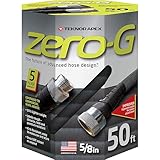
Teknor Apex Zero-G Hose
The semi-collapsible design of the Zero-G hose addresses a specific pain point: storage and transport. Unlike traditional hoses that maintain a fixed shape when empty, the Zero-G partially collapses once drained, making it genuinely compact for carrying or storing in a garage.
This hybrid approach uses a watertight inner tube surrounded by a tightly woven reinforced casing. The construction maintains flexibility for easy maneuvering while resisting kinks effectively. Weight sits between lightweight polyurethane and traditional rubber, making it manageable for most users.
Available in 50-foot lengths with standard threaded fittings, the Zero-G connects to any standard nozzle or spray gun. The material handles temperatures from 40°F to 160°F adequately for most seasonal washing conditions.
Users report this hose rarely tangles or kinks, largely due to the flexible casing that allows gentle straightening without force. The collapsible feature genuinely simplifies storage for people with limited garage space. Price sits between budget options and premium polyurethane hoses, positioning it as a smart middle choice.

POHIR Power Washer Hose (Pressure Washer Focused)
If you specifically pair car washing with pressure washer equipment, the POHIR 100-foot hose brings extended reach without sacrificing pressure performance. The 1/4-inch diameter and high-tensile wire-braided construction combine to handle 4,200 PSI working pressure.
The length matters here: 100 feet lets you position your pressure washer farther from the washing area, keeping noise and spray away from neighbors. Quick-connect M22 x 14mm fittings work with virtually all pressure washer brands. The hose includes swivel connectors on both ends to prevent tangling.
This hose requires careful initial handling—you need to lay it flat during first use to condition the material properly. After that, it performs reliably for pressure washing applications. The 4,200 PSI rating means it can handle hot-water pressure washers, unlike lighter-duty garden hoses.
This is a pressure-washer-specific hose rather than a general car-wash option, making it ideal if you own equipment-based pressure washing gear. Standard garden hose users won’t tap its full capability.

LAVEVE Lightweight Garden Hose
For people prioritizing pure weight reduction, the LAVEVE 100-foot hose delivers. Made from premium PVC with high-density textile reinforcement, it weighs 50% less than traditional rubber hoses of equivalent length.
The non-expandable construction maintains consistent water pressure throughout the hose—no fluctuations as the hose fills or empties. Standard American threaded connectors fit any nozzle. Replaceable gaskets prevent leaks at connection points, extending the hose’s usable life.
The tradeoff: this PVC-based hose won’t match the durability or temperature range of rubber or polyurethane alternatives. It works well for seasonal car washing in moderate climates, but wouldn’t be my first choice if you wash year-round in cold regions.
The real strength appears when you prioritize lightweight handling. Mobile car detailers who wash 5-10 vehicles daily benefit enormously from the weight reduction that accumulates across hours of work.
How Length and Pressure Loss Affect Your Setup
Many people assume longer hoses automatically create problems. The reality is more nuanced.
Pressure loss across the hose length follows a predictable pattern. For a 3/8-inch hose with a typical 3 GPM flow, you lose roughly 50 PSI per 100 feet. For a 5/16-inch hose with the same flow, expect about 25-30 PSI loss per 100 feet. This sounds significant until you consider baseline pressure: most pressure washers operate at 2,500-4,000 PSI. A 50 PSI loss on a 2,500 PSI system equals a 2% reduction—barely noticeable.
Practical distance guidelines:
For washing a single car in a typical driveway (20-30 feet from a water source), a 50-foot hose provides ample reach with zero meaningful pressure loss. The mathematics: at 30 feet, using a 3/8-inch hose, you’re losing roughly 15 PSI. Negligible.
For larger properties or commercial detailing operations, 75-100 foot hoses extend reach without pressure degradation that impacts cleaning power. The pressure loss at 100 feet reaches 50 PSI on a 3/8-inch hose—still only 2% on a 2,500 PSI system.
Length becomes a consideration only when you exceed 300 feet, an uncommon residential scenario. The real limitation appears in handling: longer hoses weigh more (if rubber-based) and require more effort to maneuver and coil.
Choose length based on your space, not theoretical pressure loss. Add 20-30 feet beyond your estimated distance to account for corners and obstacles. A 75-foot hose serves most residential and semi-professional car washing needs.
Finding the Hose and Nozzle Combination That Works
Professional detailers consistently pair specific hoses with specific nozzles, and there’s a reason: compatibility matters beyond just fitting threads.
The Flexzilla SwivelGrip paired with the Orbit Proflo D-Grip nozzle represents the gold standard in car detailing circles. The Flexzilla’s lightweight, kink-resistant properties combine with the Orbit’s adjustable spray patterns and ergonomic grip. The Proflo switches seamlessly between misting, cone, and fan spray patterns—essential versatility for car washing that covers everything from initial rinsing to delicate paint protection.
For pressure-washer-based setups, pairing the POHIR 100-foot hose with adjustable spray nozzles rated for 4,000+ PSI becomes critical. Standard garden nozzles lack pressure ratings for powered equipment and can fail catastrophically.
The underlying principle: your hose must match your nozzle’s pressure requirements, and both should suit your water source. Garden spigots deliver roughly 60-80 PSI; pressure washers deliver 2,500+ PSI. Attempting to use pressure-washer hoses with garden spigots wastes the hose’s capability, while trying to use garden hoses with pressure washers risks failure.
For standard garden hose car washing—the most common scenario—pairing a quality hose like Flexzilla or Continental with a solid brass adjustable nozzle covers everything you’ll encounter. Avoid plastic nozzles; brass fittings resist corrosion and last for decades, while plastic degrades within seasons.
Maintaining Your Hose for Maximum Lifespan
How you treat your hose determines whether it lasts two seasons or ten years.
Drain completely after every use. Water left inside creates opportunities for mineral deposits (in hard-water areas) and microbial growth that eventually clogs the interior. Pressure washers should be drained according to manufacturer specifications—many have drain plugs specifically for this purpose.
Store in shade. UV exposure breaks down rubber and polyurethane gradually, accelerating material degradation. A simple garage or outdoor hose reel keeps your hose protected from direct sunlight. Dark coverings extend lifespan if outdoor storage is your only option.
Avoid coiling too tightly. While some hoses coil compactly, excessively tight coiling stresses the material, especially polyurethane. Loose coils, even if they take more space, preserve flexibility. Think of it as hose exercise—gentle handling extends functional lifespan.
Check connections periodically. Brass fittings can corrode, especially in salty or humid environments. A few minutes monthly with a soft brush keeps connection points clean. Replaceable gaskets (on hoses that include them) cost a few dollars and prevent leaks that waste water and pressure.
Inspect for cracks or soft spots during monthly maintenance. Small cracks evolve into failures without warning, especially under pressure. If you notice softening (the material feeling less firm than before), the hose’s structural integrity is compromised, and replacement is approaching.
Making Your Final Choice
The single best water hose for car washing depends on your specific situation. Universal recommendations miss this reality.
Choose Flexzilla if: You wash regularly, want a hose that works reliably for 5+ years, prioritize lightweight handling for comfort, and can justify the premium price.
Choose Continental if: You need maximum durability in extreme temperatures, work in harsh environments where abrasion resistance matters, and don’t mind the additional weight.
Choose Teknor Zero-G if: Storage space is limited, you want a hose that handles well without excessive weight, and you prefer mid-range pricing.
Choose LAVEVE if: Weight reduction is your primary concern, you live in a moderate climate, and you wash seasonally rather than year-round.
Choose a pressure-washer-specific hose only if you own equipment-based pressure washing gear. Standard garden hoses handle pressure washer applications poorly.
The investment in a quality water hose pays dividends through reduced frustration, better washing results, and years of dependable performance. Your car’s finish deserves equipment that supports the care you’re giving it.